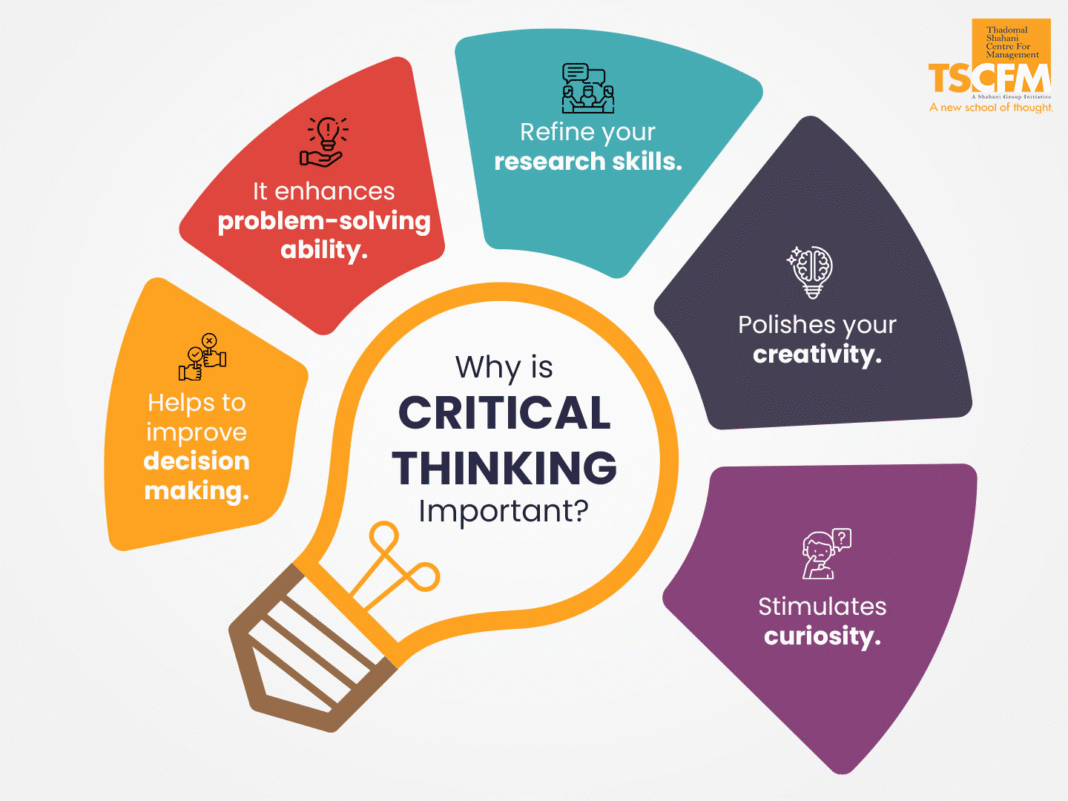
Understanding Critical Thinking
Critical thinking is defined as the ability to analyze information, evaluate it critically, and synthesize it in a coherent manner. This intellectual process is paramount for both personal and professional development, as it equips individuals to navigate complex problems with confidence and clarity. In essence, critical thinking enables a person to approach situations logically, utilizing rational thought to form judgments and make informed decisions.
At its core, critical thinking involves several key characteristics. A critical thinker is often characterized by a curious mindset, demonstrating an eagerness to explore various perspectives on an issue. They tend to question assumptions, investigate different viewpoints, and ascertain the validity of information before drawing conclusions. Furthermore, critical thinkers possess strong analytical abilities, enabling them to dissect arguments, identify flaws in reasoning, and assess the merit of evidence presented. This capacity for thorough analysis is essential for effective decision-making.
Within a professional context, critical thinking can significantly enhance problem-solving skills. Professionals who employ critical thinking are better equipped to handle challenges, as they can evaluate possible solutions methodically. This leads to more calculated and effective strategies in decision-making processes. Moreover, critical thinking fosters innovation through creative problem-solving, as individuals are encouraged to develop new ideas and approaches based on objective assessment rather than preconceived notions.
In personal settings, the ability to think critically can transform how individuals make choices in everyday life, from financial decisions to interpersonal relationships. By cultivating critical thinking skills, one can navigate personal dilemmas more adeptly, leading to choices that align more closely with one’s values and goals.
The Role of Curiosity in Critical Thinking
Curiosity plays a pivotal role in enhancing critical thinking skills, serving as a catalyst for deeper inquiry and understanding. At its core, critical thinking requires one to not only analyze information but to also question assumptions, evaluate evidence, and draw conclusions based on logic and reasoning. Curiosity encourages individuals to engage actively with the world around them, leading to the exploration of new ideas and perspectives.
Asking questions is fundamental to the process of critical thinking; it enables an individual to seek clarification, challenge existing beliefs, and uncover underlying motives in various situations. When individuals adopt a curious mindset, they are more likely to inquire about the context of issues, ask “why” and “how,” and explore topics beyond the surface level. This habit promotes a comprehensive understanding, allowing for more nuanced analyses.
Seeking new information is another key aspect where curiosity intersects with critical thinking. In today’s fast-paced world, information is readily available; however, it requires one to be inquisitive to distinguish between credible sources and misinformation. By actively pursuing knowledge, individuals sharpen their critical thinking skills, developing the ability to assess the reliability of various inputs and make informed decisions. The drive for knowledge fosters the examination of different viewpoints, promoting flexibility in thought processes.
Remaining open-minded is essential for effective critical thinking. A curious person is typically willing to entertain different perspectives, which can drastically enhance the analysis of complex issues. This openness allows for creativity in problem-solving and a better grasp of the multifaceted nature of real-world situations. Consequently, curiosity functions as a foundation for critical thinking, empowering individuals to explore, question, and synthesize information adeptly.
Developing Analytical Skills
Enhancing analytical skills is vital for effectively tackling complex problems and making informed decisions. One of the primary methods to develop these skills is through diagramming problems. This technique allows individuals to visualize relationships between various components of a problem, facilitating a clearer understanding. For instance, flowcharts and mind maps can be utilized to outline the processes involved and identify critical factors needing attention.
Another method for refining analytical skills involves data interpretation. It is essential to be proficient in analyzing quantitative and qualitative data, as this ability enables individuals to draw meaningful insights. Engaging with statistical analyses and interpreting research findings can significantly bolster one’s ability to assess situations critically. This process also aids in recognizing patterns and trends, which are invaluable in formulating solutions.
Furthermore, comparing different viewpoints plays a crucial role in the development of analytical skills. Engaging with diverse perspectives allows individuals to challenge their assumptions and broaden their understanding of the problem at hand. This can be accomplished through discussions with peers, conducting literature reviews, or exploring case studies where different approaches are employed. By weighing these various viewpoints, one can cultivate a more nuanced understanding, leading to better problem-solving capabilities.
Lastly, practicing these techniques regularly is essential. Just as any skill requires repetition and refinement, so too do analytical skills. Participating in activities such as puzzles, strategy games, or critical writing can provide ample opportunities to enhance one’s analytical thinking. By incorporating these methods into daily routines, individuals can progressively build a robust foundation for analytical skills, ultimately empowering their critical thinking capacity.
Practicing Reflection and Self-Assessment
Reflection and self-assessment are essential components in the development of critical thinking skills. Engaging in reflective practices allows individuals to pause and introspect their thoughts, decisions, and the underlying processes that drive their conclusions. This introspection can help uncover implicit biases, which often cloud judgment and impede effective reasoning. By regularly evaluating one’s thought processes, individuals not only recognize their biases but can also actively work towards questioning and mitigating them.
To incorporate reflection into daily routines, one can start by maintaining a journal dedicated to documenting thoughts and experiences. This practice encourages individuals to articulate their reasoning and to dissect the factors influencing their decisions. By reviewing earlier entries, individuals can identify patterns in their thinking, pinpoint areas of weakness, and recognize any recurring biases. This method of self-assessment is not only a tool for personal growth but also fosters a deeper understanding of the complexities surrounding their decision-making processes.
Moreover, seeking feedback from peers or mentors can enhance the self-assessment process. Openly discussing decisions and thought processes encourages constructive criticism and can provide different perspectives that one may not have considered. Engaging in dialogue about one’s reasoning can highlight omissions in logic or reveal unfounded assumptions, thereby broadening one’s critical thinking abilities. Another technique is to actively challenge oneself by exploring opposing viewpoints and debating these stances, which can further refine one’s reasoning skills.
Incorporating these practices into daily life not only strengthens critical thinking but fosters a lifetime habit of continuous improvement. By embracing reflection and self-assessment, individuals empower themselves to become more effective thinkers, capable of navigating complex issues with greater clarity and understanding.
Engaging in Discussions and Debates
Engaging in discussions and debates is a powerful method to strengthen critical thinking skills. When individuals actively participate in conversations that challenge their beliefs and perspectives, they are provided with opportunities to analyze different viewpoints. This exchange of ideas encourages individuals to articulate their thoughts clearly and defend their reasoning, which is a crucial component of critical thinking.
By engaging in discussions, individuals can encounter a range of perspectives that may differ significantly from their own. This exposure is essential, as it promotes open-mindedness and allows for the consideration of alternative arguments. It also encourages individuals to ask questions and seek clarification, fostering a deeper understanding of complex issues. Critical thinking is enhanced when one learns to evaluate the strengths and weaknesses of various arguments presented during these discussions.
Furthermore, debates specifically require participants to take a stance on an issue, which compels them to research and gather evidence to support their position. This not only deepens their knowledge but also trains them to identify logical fallacies and biases, both in their reasoning and that of their opponents. The pressure to think on their feet during debates further sharpens their analytical skills, making it easier for them to process information quickly and effectively.
In conclusion, engaging in discussions and debates can significantly enhance critical thinking skills. The active exchange of ideas not only challenges one’s own viewpoints but also encourages deeper understanding and reasoning. Therefore, participating in such dialogues should be considered a fundamental practice for anyone looking to cultivate their critical thinking abilities.
Learning to Evaluate Evidence and Sources
In an age where information is abundant, discerning credible evidence and trustworthy sources is pivotal for strengthening one’s critical thinking skills. To effectively evaluate evidence, individuals must first understand the core components of reliability, bias, and relevance. Reliable evidence is typically supported by strong research, well-documented facts, and a clear methodology. Consequently, individuals should prioritize sources that provide citations, peer-reviewed studies, or well-established publications that adhere to ethical standards in research.
One effective technique for assessing evidence is the CRAAP test, which evaluates Currency, Relevance, Authority, Accuracy, and Purpose. Asking questions like, “Is the information up-to-date?” and “Does it directly relate to my topic?” can help clarify the significance of the evidence. When considering the authority of a source, one should scrutinize the author’s credentials and affiliations—experts in a given field are more likely to provide reliable insight.
Bias is another critical aspect that must be evaluated. It is essential to recognize personal biases and the potential biases of the source. This aspect can significantly affect the interpretation and presentation of evidence. By seeking diverse perspectives and contrasting viewpoints, one can mitigate the influence of bias on personal judgments. Additionally, examining the intent behind information, such as whether it aims to inform, persuade, or sell, can provide deeper insights into its credibility.
Furthermore, always cross-reference multiple sources when evaluating a piece of evidence. A consistent finding across diverse, reputable sources enhances its reliability. There are also numerous digital literacy resources available, including online courses and workshops, which can provide further training on evaluating information effectively. By following these guidelines, individuals can hone their ability to assess evidence and sources critically, which will in turn enrich their overall critical thinking skills.
Applying the Socratic Method
The Socratic Method is a pedagogical approach characterized by the use of probing questions to stimulate critical thinking and illuminate ideas. Named after the classical Greek philosopher Socrates, this method encourages individuals to engage in dialogue, challenging assumptions and exploring beliefs in a systematic manner. By adopting this technique, one can significantly enhance their critical thinking capabilities.
At its core, the Socratic Method operates on the premise that questioning is a more effective means of learning than providing direct answers. This approach involves three essential stages: the formulation of a question, the pursuit of clarity through dialogue, and the examination of underlying assumptions. To apply this method, individuals should start by identifying a topic or problem that warrants deeper exploration. From there, they can develop a series of open-ended questions designed to provoke thought and discussion.
For instance, when exploring a complex issue such as ethical dilemmas in business, one might ask, “What are the potential implications of prioritizing profit over ethics?” Such a question encourages participants to consider various perspectives and delve into moral principles. Effective questioning can lead to insights that challenge preconceived notions and stimulate further inquiry.
Moreover, engaging with others utilizing the Socratic Method not only aids in clarifying one’s own understanding but also enhances the collective critical thinking within a group. Participants learn to articulate their reasoning and defend their viewpoints grounded in evidence. This collaborative aspect fosters an environment where critical analysis thrives, as individuals work together to dissect complex ideas.
In conclusion, mastering the Socratic Method equips individuals with a powerful tool for enhancing their critical thinking skills. By consistently applying probing questions and actively engaging in discourse, one can uncover deeper insights and develop a more nuanced understanding of various topics.
Mind Mapping for Better Understanding
Mind mapping is an innovative visual technique that greatly enhances critical thinking skills by allowing individuals to organize their thoughts coherently. As an effective brainstorming tool, mind mapping enables users to visually display information, thus promoting a deeper comprehension of complex topics. This method is particularly beneficial for breaking down intricate ideas into manageable sections, which facilitates easier submission to analysis and evaluation.
The concept of mind mapping revolves around the creation of diagrams that represent words, ideas, tasks, or concepts linked around a central theme. The core idea appears in the center, while associated thoughts branch outwards, creating a network of relationships between different ideas. This spatial arrangement not only helps to illustrate the connections between concepts but also serves as a stimulative exercise, encouraging the generation of new ideas. By visually laying out thoughts, mind mapping clears cognitive clutter, allowing individuals to focus on relevant information and encouraging critical engagement.
Additionally, mind mapping taps into the brain’s natural propensity for visual processing, making it a more effective method of retention compared to traditional list-making techniques. By integrating colors, symbols, and images, mind maps become more memorable, promoting long-term understanding and analysis of content. Given its versatility, mind mapping is applicable across various domains, from education to business strategy development, further aiding in the enhancement of critical thinking skills. Overall, by employing mind mapping, individuals can derive insights from information more effectively, nourishing their ability to think critically and solve problems with greater efficacy.
Continuous Learning and Adaptation
Critical thinking is a skill that can be developed and refined through continuous learning and adaptation. Engaging in lifelong learning enables individuals to explore various viewpoints, ideas, and methodologies, which is essential for enhancing one’s critical thinking abilities. In an ever-evolving world, it is imperative to adapt to new information and challenges that arise. This allows for more effective problem-solving and decision-making.
One effective way to foster continuous learning is to embrace new challenges. Stepping out of one’s comfort zone by tackling unfamiliar tasks or subjects can stimulate cognitive processes. Such experiences provoke individuals to analyze situations from various angles, thus honing their critical thinking skills. Whether it’s engaging in a new hobby, tackling a complex project at work, or pursuing further education, each challenge provides an opportunity for growth.
Moreover, staying informed about diverse subjects is crucial. Engaging with literature, attending workshops, or partaking in discussions can expose individuals to a range of perspectives, enhancing their ability to think critically about complex issues. Reading broadly and critically assessing information enables individuals to differentiate between reliable sources and biased content, which is vital in cultivating sound judgment. It is also beneficial to seek feedback from others to gain insights into different approaches and viewpoints, further enriching the learning process.
In conclusion, the importance of continuous learning and adaptability in strengthening critical thinking skills cannot be overstated. By committing to lifelong learning and remaining open to new challenges and ideas, individuals can enhance their ability to think critically in an increasingly complex world.

