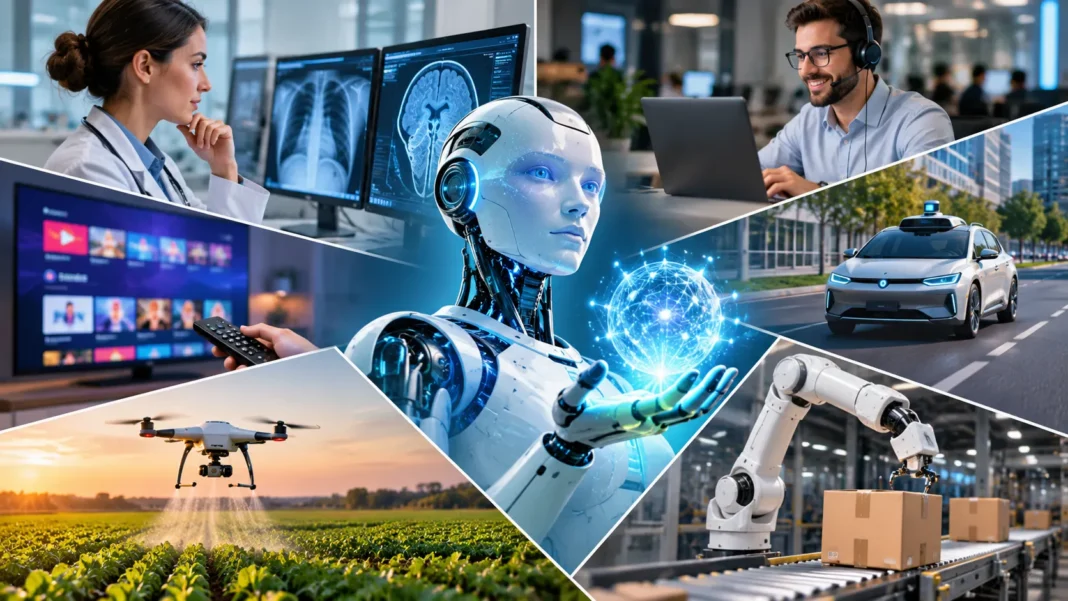
Artificial intelligence is changing how people work, communicate, learn, and solve everyday problems. From personalized recommendations to advanced medical research, AI-powered systems are becoming part of many industries. Understanding artificial intelligence applications helps individuals and businesses recognize how this technology works and where it can provide practical benefits.
Today, organizations use artificial intelligence to analyze information, automate repetitive tasks, and support decision-making. These systems can recognize patterns, process language, generate content, and identify useful insights from large amounts of data. As AI technology develops, its applications continue to expand into areas such as healthcare, education, transportation, finance, and manufacturing.
However, artificial intelligence is not a perfect solution for every problem. Its effectiveness depends on data quality, system design, human oversight, and responsible implementation. This guide explores the major applications of artificial intelligence, provides practical examples, and explains the benefits, limitations, and future possibilities of AI across different industries.
What Are Artificial Intelligence Applications?
Artificial intelligence applications are practical uses of computer systems designed to perform tasks that normally require aspects of human intelligence. These tasks may include recognizing images, understanding language, identifying patterns, making predictions, and generating information. AI applications often use machine learning algorithms and other computational techniques to process data and produce useful results.
Some AI systems perform narrow, specialized tasks, such as detecting suspicious transactions or recommending products. Others combine multiple capabilities to support more complex activities, including document analysis, customer assistance, and business planning. The specific technology depends on the problem being solved and the information available to the system.
Artificial intelligence is often integrated into existing software rather than operating as a separate product. For example, email platforms may use AI to identify unwanted messages, while navigation applications predict traffic conditions. These familiar tools demonstrate how artificial intelligence can improve everyday digital experiences without requiring users to understand complicated technical processes.
How Artificial Intelligence Works in Real-World Applications
Most modern artificial intelligence systems rely on algorithms that process information and identify relationships within data. Machine learning models learn patterns from examples rather than following only manually programmed rules. After training, these models can apply their learned patterns to new information and produce predictions, classifications, or generated responses.
Different AI applications require different technologies depending on their intended purpose. Computer vision helps systems interpret visual information, while natural language processing supports communication involving written or spoken language. Predictive analytics estimates possible future outcomes using historical patterns and relevant variables from existing datasets.
For example, an AI-powered customer support tool may analyze a question and identify an appropriate response. A medical imaging system may highlight unusual patterns for professional review, while a recommendation engine suggests relevant content. Although these applications perform different functions, they share the ability to process information using computational models.
Artificial Intelligence Applications in Healthcare
Healthcare organizations use artificial intelligence to support medical research, clinical workflows, and the analysis of complex health information. AI systems can assist with interpreting medical images, organizing patient records, and identifying patterns in large datasets. These applications aim to help healthcare professionals work more efficiently while supporting informed clinical decisions.
Medical imaging is one of the most established areas of healthcare AI research and implementation. Certain systems can highlight findings in X-rays, scans, or other diagnostic images for review by trained professionals. AI is also being explored for drug discovery, disease risk prediction, and the development of more personalized treatment approaches.
However, healthcare AI requires particularly careful validation because incorrect results can affect patient safety. Models may perform differently across hospitals, patient populations, and types of medical data. For this reason, clinical applications need appropriate regulatory oversight, privacy protections, professional judgment, and ongoing evaluation rather than unquestioned reliance on automated recommendations.
Artificial Intelligence Applications in Education
Artificial intelligence is increasingly used to support teaching, learning, and educational administration. AI-powered learning platforms can provide practice questions, explain difficult concepts, and adjust activities based on a student’s progress. These capabilities may help educators offer more personalized support while reducing time spent on certain repetitive tasks.
Students can use appropriate AI tools to explore unfamiliar subjects, practice language skills, and receive feedback on written assignments. Teachers may use AI to develop lesson materials, organize classroom resources, or identify topics requiring additional attention. However, AI-generated explanations and answers should be checked because they can contain inaccuracies.
Educational institutions must also consider academic integrity, student privacy, and unequal access to technology. Overreliance on automated systems may reduce opportunities for independent thinking and problem-solving. Responsible use involves treating artificial intelligence as a learning aid that supports, rather than replaces, teachers and meaningful student participation.
Artificial Intelligence Applications in Business Operations
Businesses use artificial intelligence to organize information, automate routine activities, and improve operational efficiency. Common applications include document processing, workflow management, demand forecasting, and internal knowledge assistance. These tools can reduce manual administrative work and help employees spend more time on tasks requiring judgment and collaboration.
For example, an organization may use AI to categorize incoming documents or summarize large collections of business information. Another company might analyze operational data to identify recurring delays or opportunities for process improvement. These applications are especially useful when organizations handle significant amounts of structured or unstructured information.
Successful business implementation requires more than simply purchasing AI software. Companies need reliable data, clear objectives, employee training, and appropriate performance evaluation. Human oversight remains important because automated systems can produce errors, overlook unusual situations, or recommend actions that do not reflect an organization’s actual circumstances.
Artificial Intelligence Applications in Customer Service
Customer service is a common area where businesses apply artificial intelligence to support everyday communication. AI chatbots and virtual assistants can answer frequently asked questions, explain standard procedures, and help customers locate relevant information. These tools may provide assistance outside regular business hours and reduce the workload associated with repetitive inquiries.
More advanced customer service systems can help classify support requests and direct complex issues to appropriate employees. AI may also summarize previous conversations so human representatives can understand customer concerns more quickly. When implemented carefully, these features can improve consistency and reduce unnecessary delays in service interactions.
However, automated assistance should not prevent customers from reaching human support when necessary. Chatbots may misunderstand unusual questions, provide outdated information, or struggle with sensitive situations. Businesses should maintain clear escalation procedures, review automated responses, and protect personal information shared during customer interactions.
Artificial Intelligence Applications in Digital Marketing
Digital marketers use artificial intelligence to analyze audiences, organize campaign information, and improve content workflows. AI tools can help identify patterns in customer behavior, generate draft materials, and evaluate campaign performance. These capabilities support marketing teams that need to work with large amounts of information across multiple digital channels.
In search engine optimization, AI can assist with keyword grouping, content planning, and identifying potential gaps in website information. Marketing professionals may also use predictive models to estimate campaign outcomes or segment audiences. However, these suggestions require human review because automated recommendations do not always reflect search intent or customer needs.
Effective AI-assisted marketing depends on useful information, transparent practices, and original content that serves readers. Publishing large amounts of automatically generated material without checking accuracy can reduce quality and trust. Businesses should combine AI efficiency with editorial judgment, audience research, and clear communication rather than treating automation as a replacement for marketing expertise.
Artificial Intelligence Applications in Finance and Banking
Financial institutions use artificial intelligence to analyze transactions, assess risks, and support customer service operations. Machine learning models can help identify unusual activity that may indicate fraud or account misuse. Banks also use automated systems to organize financial documents and improve the efficiency of routine administrative procedures.
AI-powered analytical tools can examine historical financial information and identify patterns relevant to forecasting or risk management. Some institutions use these systems to support credit assessments and monitor operational performance. Financial applications often involve sensitive information, making accuracy, security, and regulatory compliance especially important.
AI-generated financial predictions are not guarantees because economic conditions and customer circumstances can change unexpectedly. Automated decisions may also create unfair outcomes if training data or model design introduces bias. Responsible financial AI therefore requires appropriate testing, explainability, human review, and safeguards that protect customers from avoidable harm.
Artificial Intelligence Applications in Transportation
Transportation systems use artificial intelligence to analyze traffic, optimize routes, and improve operational planning. Navigation applications can combine historical traffic patterns with current information to estimate travel times. Logistics companies may also use AI to plan deliveries and reduce delays caused by inefficient scheduling or changing transportation conditions.
AI plays an important role in the development of advanced driver-assistance technologies and autonomous vehicles. These systems may use cameras, sensors, and computational models to recognize road features and surrounding objects. However, their capabilities differ substantially, and not every vehicle equipped with AI-based assistance can operate independently.
Public transportation providers can also analyze passenger demand to support scheduling and resource allocation. Predictive maintenance systems may identify equipment conditions that deserve inspection before failures occur. Despite these benefits, transportation AI requires strong safety testing, reliable infrastructure, and human accountability because technical errors can have serious consequences.
Artificial Intelligence Applications in Manufacturing
Manufacturing companies apply artificial intelligence to monitor equipment, inspect products, and improve production planning. Computer vision systems can help identify visible defects, while predictive models analyze machine information for signs of potential problems. These tools may reduce avoidable interruptions and support more consistent production processes.
AI can also assist manufacturers with inventory management and estimating future demand. By examining production data and supply patterns, organizations can identify opportunities to improve scheduling and resource allocation. Some manufacturing environments combine AI with robotics to perform repetitive tasks under controlled operating conditions.
However, manufacturing systems must be tested carefully before being introduced into critical production workflows. Incorrect predictions or unreliable automated inspections can create quality and safety problems. Organizations should maintain human supervision, equipment maintenance procedures, and regular performance checks to ensure that automation supports dependable manufacturing operations.
Artificial Intelligence Applications in Agriculture
Agriculture is another industry where artificial intelligence can support better information and resource management. AI-powered tools may analyze crop images, environmental measurements, and weather information to identify developing problems. Farmers and agricultural specialists can use these insights to support decisions about crop monitoring, irrigation, and field management.
Computer vision systems are being developed to recognize certain plant diseases, pests, and visible crop conditions. Predictive models can also estimate agricultural outcomes using relevant historical and environmental data. These applications may help agricultural businesses respond more efficiently to changing conditions and reduce unnecessary resource use.
Nevertheless, agricultural AI depends heavily on reliable local information and suitable technology. Models developed for one crop, region, or climate may not perform equally well elsewhere. Farmers should interpret automated recommendations alongside field observations, professional knowledge, and local conditions rather than assuming digital predictions are always accurate.
Artificial Intelligence Applications in Cybersecurity
Cybersecurity teams use artificial intelligence to identify suspicious activity and manage large amounts of security information. AI systems can analyze network behavior, examine system logs, and detect unusual patterns that deserve investigation. These capabilities may help organizations recognize potential threats more quickly than manual monitoring alone.
Machine learning is particularly useful for examining complex datasets containing many routine security events. Automated tools can prioritize alerts, classify suspicious files, and support analysts during investigations. Some systems also help security teams summarize incidents and identify relationships between events occurring across different parts of an organization.
However, AI does not eliminate cybersecurity threats or guarantee that every attack will be detected. Security models may generate false alerts or overlook unfamiliar behavior, while attackers can also use automation. Effective protection requires layered security controls, trained professionals, regular updates, and careful evaluation of automated detection systems.
Artificial Intelligence Applications in Retail and E-Commerce
Retail businesses use artificial intelligence to analyze shopping patterns, manage inventory, and improve digital customer experiences. Recommendation systems can suggest products based on browsing activity, previous interactions, and related information. These applications aim to make product discovery more relevant while helping retailers understand changing customer preferences.
AI can also support demand forecasting and inventory planning across physical stores and online platforms. Businesses may use predictive models to estimate which products require additional stock or identify potential supply problems. Customer service automation and product information management are additional areas where artificial intelligence can reduce repetitive work.
Retail AI should be implemented with attention to customer privacy and transparency. Recommendation systems may reinforce limited choices or rely on personal information that requires careful handling. Responsible retailers should provide accurate product information, respect data protection requirements, and ensure that automated experiences remain useful rather than unnecessarily intrusive.
Artificial Intelligence Applications in Entertainment and Media
Entertainment platforms use artificial intelligence to recommend movies, television programs, music, and other digital content. These systems analyze viewing or listening patterns to identify material that may interest individual users. Recommendation technology helps people navigate large content libraries, although it can sometimes limit exposure to unfamiliar options.
AI is also used in media production workflows, including transcription, editing assistance, and the organization of digital assets. Generative AI tools can help develop original creative concepts, produce draft visuals, or support selected production tasks. Human creativity and professional review remain important because automated outputs may contain errors or raise intellectual property concerns.
Media organizations must also consider transparency when using synthetic images, voices, or generated content. Misleading presentations can damage audience trust, particularly when realistic material is presented without appropriate context. Ethical implementation involves respecting creators’ rights, obtaining necessary permissions, and clearly communicating when AI-generated media could otherwise confuse audiences.
Artificial Intelligence Applications in Human Resources
Human resources departments use artificial intelligence to organize recruitment information and improve administrative workflows. AI tools can help prepare job descriptions, categorize applications, and answer routine employee questions. These capabilities may reduce time spent on repetitive processes and allow HR professionals to focus on communication and employee support.
Some organizations also use analytical models to study workforce trends or identify training needs. AI-assisted learning platforms may recommend educational materials based on employee roles and development goals. However, employment decisions involve individual circumstances that automated systems may not understand accurately or fairly.
Recruitment and workforce AI require particularly careful attention to discrimination, privacy, and accountability. Models trained on historical employment data may reproduce unfair patterns if they are not properly evaluated. Organizations should test systems for bias, provide appropriate human oversight, and avoid relying solely on automated scores for consequential employment decisions.
Benefits of Artificial Intelligence Across Industries
One major benefit of artificial intelligence is its ability to process large amounts of information quickly. AI systems can help identify patterns, organize documents, and support repetitive workflows that would otherwise require considerable manual effort. These capabilities may improve productivity when the technology is appropriately matched to a genuine operational need.
Another advantage is the potential for more personalized services and useful predictions. Educational platforms can adapt learning activities, while businesses may use forecasting tools to improve resource planning. AI can also support accessibility through features such as speech recognition, transcription, and assistance with interpreting digital information.
However, the benefits of AI depend on successful implementation rather than the technology alone. A poorly designed system may increase costs, create additional work, or produce unreliable information. Organizations should evaluate measurable outcomes, consider user needs, and maintain human oversight to determine whether an AI application delivers meaningful value.
Challenges and Limitations of Artificial Intelligence Applications
Artificial intelligence systems can produce inaccurate results, particularly when they encounter unfamiliar information or poorly defined tasks. Generative AI may create convincing statements that are factually incorrect, while predictive models can make unreliable estimates. These limitations mean that important decisions should not depend on unverified automated outputs.
Data privacy and algorithmic bias are additional concerns across many industries. AI applications may process sensitive personal information, and models can produce unfair results when training data contains imbalances or historical discrimination. Responsible deployment requires suitable data protection measures, appropriate testing, and procedures for identifying and correcting harmful outcomes.
Cost, technical complexity, and employee training can also create barriers to adoption. Organizations may struggle to integrate AI tools with existing systems or measure whether they actually improve performance. Clear objectives, realistic expectations, and continuous monitoring are essential for reducing these challenges and supporting sustainable use.
Future Trends in Artificial Intelligence Applications
Future artificial intelligence applications are likely to involve closer integration between AI tools and everyday software systems. Organizations are exploring systems that can assist with multi-step workflows, organize information across applications, and support more complex tasks. These developments may make AI increasingly useful for activities requiring coordination between different digital tools.
Advances in multimodal AI are also expanding the kinds of information systems can process together. Models that work with text, images, audio, and video may support more flexible communication and analysis. Potential applications include improved accessibility tools, interactive educational systems, and more capable assistance for specialized professional workflows.
Despite these developments, future adoption will depend on reliability, affordability, regulation, and public trust. Organizations will need to evaluate both the benefits and risks of increasingly capable systems. The most valuable progress will come from applications that address real problems while maintaining appropriate human control, transparency, and accountability.
Conclusion
Artificial intelligence applications now support a wide range of activities across healthcare, education, business, finance, transportation, and many other industries. These systems can analyze information, automate selected tasks, and provide useful assistance with complex workflows. Their growing presence demonstrates how computational technologies are becoming integrated into everyday services and professional environments.
However, artificial intelligence should be understood as a collection of tools rather than a universal replacement for human expertise. Accuracy, fairness, privacy, and safety remain important considerations whenever automated systems influence real-world outcomes. Organizations that combine technical capabilities with responsible oversight are better positioned to achieve useful and dependable results.
As AI technology continues to develop, individuals and businesses will have more opportunities to explore practical applications. Understanding the strengths and limitations of these systems can support better decisions about when and how to use them. Ultimately, successful AI adoption depends on solving meaningful problems while keeping human needs at the center of implementation.
Frequently Asked Questions
What are the most common applications of artificial intelligence?
Common artificial intelligence applications include customer service chatbots, recommendation systems, medical image analysis, fraud detection, predictive maintenance, and language processing. These technologies help organizations analyze information and automate selected activities.
How is artificial intelligence used in everyday life?
Artificial intelligence supports everyday tools such as navigation applications, email spam filters, voice assistants, and personalized recommendations. Many people interact with AI through familiar digital services without directly noticing the underlying technology.
Which industries benefit most from artificial intelligence?
Healthcare, finance, education, retail, manufacturing, and transportation are among the industries using AI extensively. The benefits depend on specific tasks, available data, implementation quality, and appropriate human oversight.
What is the difference between AI and machine learning applications?
Artificial intelligence is the broader field of developing systems capable of performing tasks associated with human intelligence. Machine learning is one approach that enables systems to identify patterns and improve performance using data.
What are the main risks of using artificial intelligence?
Major risks include inaccurate outputs, privacy violations, biased decisions, security vulnerabilities, and excessive reliance on automation. Organizations can reduce these risks through testing, transparent practices, effective safeguards, and ongoing human supervision.

