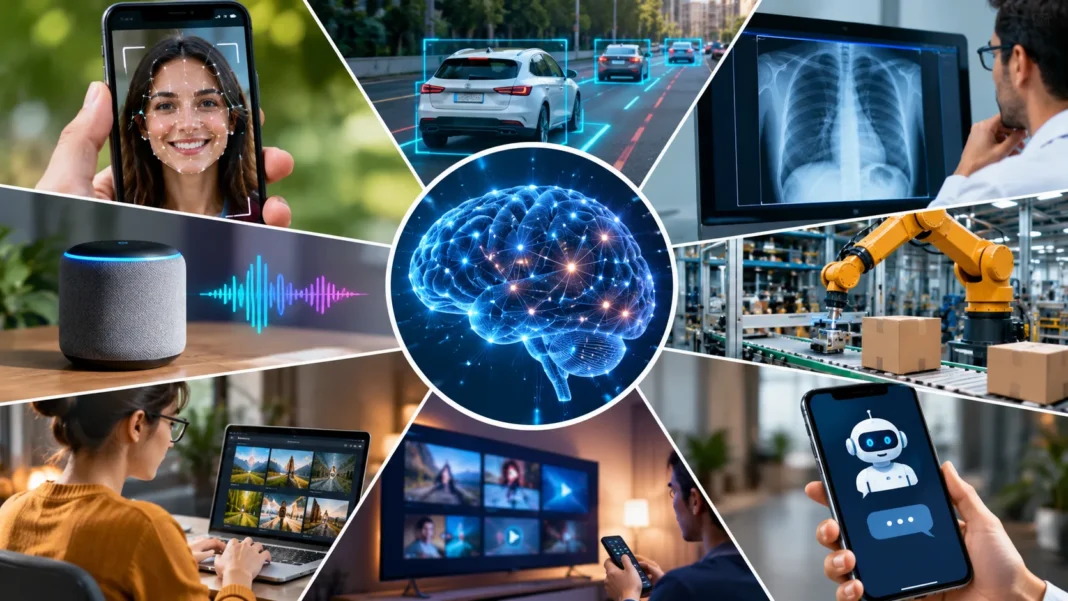
What Are Deep Learning Applications?
Deep learning applications are practical uses of artificial neural networks to solve problems, recognize patterns, and automate complex tasks. These technologies help computers process images, understand language, recognize speech, and analyze large amounts of information. Today, deep learning supports various industries, including healthcare, education, transportation, finance, manufacturing, and digital communication.
Unlike traditional software that depends mainly on predefined instructions, deep learning systems learn useful patterns from training data. They use multiple neural network layers to identify relationships and produce predictions or other outputs. This approach makes deep learning particularly useful for tasks involving complex information that cannot easily be described through simple programming rules.
Understanding deep learning applications helps people recognize how artificial intelligence influences everyday activities and professional industries. From smartphone assistants to medical imaging tools, these systems support many familiar technologies. Exploring practical examples also reveals the benefits, limitations, and responsibilities involved in using deep learning solutions effectively.
Deep Learning in Healthcare and Medical Diagnosis
Healthcare is one of the most important fields exploring practical applications of deep learning technology. Neural networks can analyze medical images, identify unusual patterns, and support healthcare professionals during diagnostic assessments. Researchers use these systems with X-rays, CT scans, MRI images, and other medical information to investigate ways of improving clinical workflows.
Deep learning models can assist with detecting certain abnormalities in medical images when properly developed and validated. For example, some systems analyze retinal photographs to identify signs associated with diabetic eye disease. However, medical AI tools require extensive testing, regulatory consideration, and clinical oversight before they can be trusted in healthcare settings.
Beyond medical imaging, deep learning supports research involving patient monitoring, medical records, and disease prediction. These applications may help healthcare teams recognize important patterns within large datasets. Nevertheless, predictions are not always accurate, and patient privacy, data quality, fairness, and professional judgment remain essential parts of responsible medical AI use.
Deep Learning Applications in Education
Deep learning is increasingly used in educational technology to support personalized learning experiences and digital teaching tools. AI-powered systems can analyze student responses, identify areas requiring additional practice, and recommend relevant learning materials. These capabilities may help educators provide more targeted support while giving students flexible opportunities to review difficult concepts.
Language learning applications can use speech recognition and natural language processing to provide pronunciation feedback and interactive exercises. Other platforms employ AI to generate practice questions, summarize educational material, or explain unfamiliar topics. However, automated feedback can contain mistakes, so learners should verify important information and continue using trusted educational resources.
Teachers may also benefit from deep learning tools that assist with administrative activities and instructional preparation. For example, AI systems can help organize learning resources or create preliminary lesson materials. Effective implementation requires attention to accessibility, student privacy, academic integrity, and the continued importance of meaningful interaction between teachers and students.
Deep Learning in Self-Driving Cars
Autonomous vehicle development relies heavily on advanced computer vision and machine learning technologies. Deep learning models process information from cameras, radar, and other vehicle sensors to identify objects and understand surrounding environments. These systems can help recognize pedestrians, vehicles, road signs, and lane markings during driving operations.
Neural networks also support perception tasks that contribute to understanding road conditions and predicting nearby movement. For example, a vehicle system may analyze visual information to estimate where another car or pedestrian could move. These predictions can support planning systems, although reliable driving requires many additional technologies beyond deep learning alone.
Real-world road environments introduce considerable challenges, including unusual weather, unexpected obstacles, and complex human behavior. Deep learning systems may struggle with unfamiliar situations or information that differs from their training examples. Consequently, autonomous driving technology requires extensive testing, safety engineering, monitoring, and regulatory oversight before being used in demanding transportation environments.
Deep Learning in Banking and Financial Services
Banks and financial organizations use machine learning technologies to analyze transactions, identify patterns, and support operational decisions. Deep learning can process complex financial datasets containing customer activity, transaction histories, and behavioral information. These capabilities make it useful for applications involving fraud detection, document processing, and certain forecasting tasks.
Fraud detection systems can examine transaction patterns and identify activities that differ from expected behavior. For example, an unusual combination of purchase location, transaction amount, and account activity may require additional investigation. Deep learning can help recognize complex relationships, but flagged transactions still need appropriate validation to avoid unnecessary disruptions for legitimate customers.
Financial institutions may also explore neural networks for credit risk assessment, customer support, and market analysis. However, financial predictions remain uncertain because economic conditions and human behavior can change unexpectedly. Responsible applications require careful evaluation, data security, fairness assessments, and compliance with relevant financial regulations.
Deep Learning Applications in E-Commerce
Online shopping platforms use deep learning to improve product discovery, search experiences, and personalized recommendations. Neural networks can analyze browsing patterns, purchase histories, and product characteristics to estimate which items may interest customers. These recommendations help shoppers explore relevant products while allowing businesses to organize large online catalogs more effectively.
Visual search is another practical application that helps customers find products using pictures instead of written descriptions. A shopper might upload an image of a jacket to discover visually similar clothing options. Deep learning models analyze features such as shape, color, and texture to identify products that resemble the uploaded image.
E-commerce companies also use AI for demand forecasting, product categorization, and customer service assistance. These tools can support inventory planning and help businesses respond to common questions. However, recommendation quality depends on available information, and companies should handle customer data responsibly while providing transparent privacy protections.
Deep Learning in Natural Language Processing
Natural language processing focuses on helping computers analyze, interpret, and generate human language. Deep learning has significantly expanded the capabilities of modern language technologies by allowing models to learn complex relationships between words and sentences. Applications include translation, text classification, question answering, document summarization, and conversational AI.
Large language models use neural network architectures, commonly based on transformers, to process and generate text. These systems can assist with writing, research organization, programming, and many communication tasks. They learn statistical patterns from training data, although their ability to produce convincing language does not guarantee factual accuracy or genuine understanding.
Businesses use natural language processing to analyze customer feedback, organize documents, and support communication workflows. Sentiment analysis tools, for example, can classify written opinions into broad categories. Despite these advantages, language models can misunderstand context, reflect training biases, or generate incorrect information, making human review important.
Deep Learning in Speech Recognition and Voice Assistants
Speech recognition technology converts spoken language into text using computational models trained on audio recordings. Deep learning helps these systems recognize speech patterns, pronunciation differences, and relationships between sounds. Applications include voice assistants, automatic captions, transcription services, and accessibility tools for people who benefit from speech-based interaction.
Modern voice assistants combine several technologies to interpret requests and generate useful responses. Speech recognition converts audio into text, language models interpret instructions, and additional systems perform requested tasks. Some services also use neural speech synthesis to produce natural-sounding spoken responses, creating more interactive communication experiences.
Speech recognition remains challenging when background noise, overlapping conversations, or unfamiliar accents affect audio quality. Systems may also perform differently across languages and speaking styles. Improving accuracy requires diverse training data, careful testing, privacy protections, and ongoing evaluation across realistic communication environments.
Deep Learning Applications in Computer Vision
Computer vision enables computers to analyze and interpret visual information from images and videos. Deep learning models can recognize objects, classify pictures, detect movement, and identify visual patterns. These capabilities support applications in healthcare, transportation, agriculture, manufacturing, security, and many consumer technologies.
Object detection systems identify the presence and approximate location of items within visual information. For example, a model can recognize vehicles in traffic footage or identify products moving along a manufacturing conveyor. Image segmentation goes further by assigning categories to individual pixels, allowing more detailed analysis of scenes and objects.
Computer vision systems also support accessibility features, visual search, and automated image organization. However, lighting changes, unusual camera angles, and unfamiliar environments can affect accuracy. Responsible deployment requires careful testing, appropriate privacy protections, and awareness that visual recognition systems can produce mistakes or unequal performance across different populations.
Deep Learning in Agriculture and Farming
Agriculture is another field where deep learning can support improved monitoring and decision-making. Farmers and researchers use computer vision systems to analyze crops, identify visible plant diseases, and assess growing conditions. These tools may help detect potential problems earlier, allowing agricultural professionals to investigate issues before they affect larger areas.
Drones and ground-based cameras can collect images of fields for automated analysis. Neural networks may identify changes in crop appearance, estimate plant coverage, or highlight areas requiring attention. When combined with environmental measurements, these systems can support more informed decisions about irrigation, crop management, and agricultural resource allocation.
Deep learning can also contribute to agricultural research involving yield estimation and crop classification. Nevertheless, results depend on weather conditions, image quality, local farming practices, and representative training data. AI-generated recommendations should be evaluated alongside practical farming knowledge rather than treated as guaranteed solutions.
Deep Learning Applications in Manufacturing
Manufacturing companies use deep learning to support quality inspection, equipment monitoring, and industrial automation. Computer vision systems can examine products moving through production lines and identify visible defects. This approach may improve inspection consistency while reducing some repetitive manual tasks in environments where automated monitoring is appropriate.
Predictive maintenance is another application involving analysis of equipment performance data. Neural networks can examine sensor readings, vibration patterns, and operational histories to identify signs that machinery may require attention. Recognizing unusual behavior early can help maintenance teams investigate problems and potentially reduce unexpected equipment downtime.
Industrial deep learning systems must operate reliably under demanding production conditions. Poor lighting, sensor failures, and changing manufacturing processes can affect performance. Businesses should therefore combine AI tools with suitable engineering controls, employee training, and regular evaluation to maintain safety and production quality.
Deep Learning in Cybersecurity
Cybersecurity professionals use machine learning to investigate suspicious behavior and identify potential digital threats. Deep learning models can analyze network traffic, software activity, and system logs to discover patterns associated with malicious behavior. These capabilities may support security teams working with large volumes of technical information.
For example, an anomaly detection system might highlight unusual login patterns or unexpected changes in network communication. Security analysts can then investigate whether the activity represents a genuine threat or an ordinary operational event. Deep learning can assist with prioritization, but automated alerts may include false positives or overlook unfamiliar attacks.
Cybersecurity applications require continuous evaluation because attackers adapt their methods and digital environments change. Models trained on outdated information may become less effective against new threats. Combining deep learning with traditional security controls, expert analysis, and established incident response procedures provides a more balanced approach to digital protection.
Deep Learning Applications in Entertainment and Media
Entertainment platforms use deep learning to recommend movies, television programs, music, and other digital content. Recommendation models can examine viewing histories, content characteristics, and interaction patterns to predict what users may enjoy. These systems help people navigate large libraries while supporting personalized discovery experiences.
Deep learning also contributes to video editing, animation, speech processing, and visual effects production. Certain AI tools can enhance image resolution, remove background noise, or assist with generating visual elements. These applications may support creative workflows, although professional judgment remains necessary to maintain quality and artistic consistency.
Generative AI has introduced additional possibilities for creating original images, audio, and video. However, these technologies raise important questions about copyright, consent, authenticity, and creative ownership. Responsible use requires respecting intellectual property rights and avoiding misleading representations of real people or events.
Deep Learning in Marketing and Advertising
Marketing teams use deep learning to analyze audience behavior, improve campaign performance, and understand customer preferences. Neural networks can identify relationships within website activity, advertising interactions, and historical conversion data. These insights may help businesses improve how they organize campaigns and communicate with relevant audiences.
Deep learning can support customer segmentation by identifying patterns across different groups of users. For example, a business might analyze browsing behavior to better understand which product categories attract particular audiences. Predictive models can also estimate the likelihood of certain actions, although these predictions remain uncertain and depend on data quality.
Content analysis and customer feedback processing are additional marketing applications. Natural language models may help organize reviews, identify common questions, and summarize customer concerns. Marketers should prioritize transparency, privacy, and meaningful customer experiences rather than using automation to create misleading messages or exploit sensitive personal information.
Deep Learning in Weather Forecasting and Climate Research
Weather forecasting and climate research increasingly use advanced machine learning methods to analyze complex environmental information. Deep learning systems can process satellite observations, atmospheric measurements, and historical weather records. These tools may help researchers identify patterns and develop computational approaches that complement traditional physical forecasting models.
Some modern weather prediction systems use neural networks to estimate future atmospheric conditions from current observations. Their performance can be impressive for certain forecast tasks, although capabilities vary by model and weather situation. Reliable forecasting still requires careful validation, high-quality observations, and comparison with established scientific methods.
Climate researchers also explore deep learning for analyzing large environmental datasets and identifying long-term patterns. Potential applications include monitoring sea ice, mapping land-use changes, and studying extreme weather events. Nevertheless, scientific interpretation remains essential because statistical predictions alone cannot fully explain the physical processes driving environmental change.
Deep Learning Applications in Logistics and Supply Chains
Logistics companies manage complex activities involving transportation, inventory, warehouse operations, and delivery schedules. Deep learning can support these processes by analyzing historical demand, shipment information, and operational patterns. Better predictions may help organizations prepare for changes in customer demand and identify potential disruptions.
Warehouse operations can also benefit from computer vision and automated identification systems. Neural networks may help recognize packages, monitor inventory movement, or support robotic handling tasks. These applications can improve visibility across operational processes when integrated with appropriate equipment, safety procedures, and management systems.
Demand forecasting represents another useful application for supply chain planning. Models can examine historical sales, seasonal patterns, and other relevant information to estimate future requirements. However, unexpected events and changing market conditions can reduce prediction accuracy, making flexible planning and human oversight important.
Deep Learning in Smart Homes and Everyday Devices
Many everyday devices use machine learning technologies to provide more convenient digital experiences. Smartphones, smart speakers, cameras, and connected household appliances may include neural network capabilities. These systems support features such as speech recognition, image enhancement, automated organization, and certain personalized settings.
Smartphone cameras provide a familiar example of deep learning in consumer technology. Neural networks can assist with image processing, subject recognition, portrait effects, and low-light photography. These features help improve photographs automatically, although final results still depend on camera hardware, lighting conditions, and software design.
Smart home systems may also use learned patterns to support energy management and device automation. For example, connected technologies can analyze household activity and environmental measurements to adjust certain settings. Privacy remains important because connected devices may collect sensitive information about personal routines and home environments.
Deep Learning in Scientific Research and Drug Discovery
Scientific researchers use deep learning to analyze complicated datasets and investigate relationships that may be difficult to identify manually. Applications appear in biology, chemistry, physics, and materials science. Neural networks can support pattern recognition, simulation, and predictive modeling across different stages of scientific investigation.
Protein structure prediction is a notable example of deep learning contributing to biological research. Systems such as AlphaFold have demonstrated how neural networks can predict aspects of protein structure from amino acid sequences. These capabilities help scientists investigate biological questions, although predictions still require appropriate interpretation and experimental verification.
Drug discovery researchers also explore machine learning for identifying promising molecular candidates and estimating chemical properties. Such models may help prioritize laboratory experiments and reduce some exploratory work. However, developing safe and effective medicines still requires extensive scientific testing, clinical trials, and regulatory evaluation.
Benefits of Deep Learning Across Industries
One major benefit of deep learning is its ability to process complex information and identify patterns within large datasets. This capability can support tasks that would otherwise require extensive manual analysis. Industries dealing with images, audio, text, and sensor information may find neural networks particularly useful for specialized applications.
Deep learning also offers opportunities to improve efficiency through automation and decision support. Organizations can use models to classify documents, monitor equipment, and identify important information. However, the level of improvement varies according to the problem, implementation quality, available data, and the performance of alternative technologies.
Another advantage is the flexibility of neural network architectures across different use cases. Techniques developed for one field can sometimes be adapted to another through transfer learning or related methods. This adaptability encourages experimentation, although practical value depends on careful evaluation rather than assuming that deep learning always provides the best solution.
Challenges and Limitations of Deep Learning Applications
Deep learning systems often require substantial data, computing resources, and specialized technical knowledge. Training large models can involve significant financial and energy costs. Smaller organizations may therefore face challenges when developing advanced systems, particularly if suitable datasets or experienced engineering teams are unavailable.
Accuracy and reliability are equally important concerns because models can produce incorrect or misleading predictions. Bias within training datasets may also lead to unequal outcomes for different groups. Organizations should evaluate systems under realistic conditions and introduce appropriate safeguards before using AI for decisions that affect people’s opportunities or well-being.
Privacy, transparency, and accountability create additional responsibilities for organizations adopting deep learning. Sensitive information must be handled carefully, and automated decisions may require explanation or human review. Responsible development involves ongoing monitoring, clear governance, and recognition that neural networks are tools rather than replacements for professional judgment.
Future of Deep Learning Applications
The future of deep learning will likely involve broader adoption of efficient models capable of operating across different devices and environments. Researchers are exploring ways to reduce computational requirements while maintaining useful performance. These improvements could make advanced AI tools more accessible to businesses, researchers, and individual developers.
Multimodal systems represent another important direction because they can process several forms of information together. Models combining language, images, audio, and video may support more capable digital assistants and analytical tools. Potential applications include accessibility services, scientific research, education, and improved interactions between humans and computers.
As deep learning becomes more widely used, responsible implementation will remain essential. Developers must continue addressing reliability, security, bias, and environmental considerations. The most valuable future applications will be those that solve meaningful problems while maintaining appropriate human oversight, transparency, and practical safeguards.
Conclusion
Deep learning applications are transforming how organizations analyze information, automate processes, and develop intelligent technologies. From healthcare and education to finance and transportation, neural networks support numerous practical tasks. Their ability to learn complex patterns makes them particularly useful for analyzing images, language, audio, and other large datasets.
However, deep learning is not a universal solution for every problem. Successful applications require suitable training data, careful model evaluation, technical resources, and responsible management. Understanding both the opportunities and limitations helps individuals and organizations make informed decisions about adopting artificial intelligence technologies.
The greatest value of deep learning comes from applying it to real problems where measurable improvements are possible. As research progresses, new tools and techniques will continue expanding its practical capabilities. By focusing on reliability, usefulness, and responsible innovation, industries can benefit from deep learning while managing its challenges effectively.
Frequently Asked Questions
What are the most common applications of deep learning?
Common deep learning applications include image recognition, speech transcription, language translation, recommendation systems, medical image analysis, and fraud detection. These technologies use neural networks to identify complex patterns and support predictions.
How is deep learning used in everyday life?
Deep learning supports everyday features such as smartphone photography, voice assistants, personalized recommendations, automatic captions, and digital translation. Many people interact with these technologies regularly without realizing that neural networks help power them.
Why is deep learning important in healthcare?
Deep learning can help analyze medical images, identify patterns in patient data, and support healthcare research. However, clinical applications require careful validation, professional oversight, and appropriate safeguards to protect patients.
Which industries benefit the most from deep learning?
Healthcare, finance, transportation, manufacturing, technology, and e-commerce are among the industries exploring valuable deep learning applications. Benefits depend on available data, specific business problems, and successful implementation.
What is the future of deep learning applications?
Future deep learning applications may involve more efficient AI models, improved multimodal systems, advanced scientific research, and greater automation. Responsible development will remain necessary to address reliability, privacy, fairness, and security concerns.

