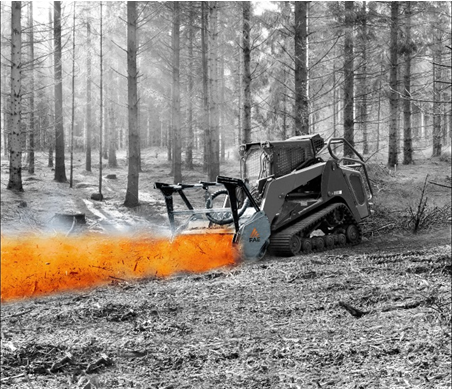

Skid steer mulchers: engineering principles and performance parameters for high-efficiency land clearing
Land clearing and vegetation management have evolved significantly over the past decade, driven by increasing efficiency demands, tighter project timelines, and the need for precise ground preparation across forestry, infrastructure, and agricultural applications. Compact equipment has become central to these operations, offering maneuverability without compromising power delivery.
Within this context, hydraulic-driven mulching attachments have emerged as a highly engineered solution capable of transforming skid steers into effective material reduction systems. Understanding the engineering principles and measurable performance parameters behind these machines is essential for evaluating operational efficiency in demanding field conditions.
Hydraulic architecture and power transmission efficiency
Operational efficiency in skid steer mulching applications begins with hydraulic system architecture. Because these attachments are entirely hydraulic-driven, overall productivity depends on how effectively hydraulic energy is converted into usable mechanical torque at the rotor.
Flow rate and pressure are not independent variables – their interaction determines real cutting performance under load. An optimized hydraulic configuration ensures consistent power delivery, reduced thermal stress, and stable rotor behavior, even when processing dense or irregular vegetation.
Flow, pressure, and torque generation
Hydraulic flow (GPM) directly influences rotor speed, while system pressure (PSI) determines the torque available to overcome resistance. A balanced combination of both parameters is essential to maintain cutting efficiency without inducing rotor stalling. Excessive flow without sufficient pressure can result in unstable performance, whereas high pressure with inadequate flow limits material processing capacity.
From an engineering standpoint, torque consistency under variable load is the key performance indicator. When vegetation density changes abruptly, the hydraulic system must respond without excessive RPM drop. Proper hydraulic matching between skid steer capacity and mulcher requirements ensures smoother power transfer, improved energy efficiency, and reduced mechanical stress on drivetrain components.
Rotor engineering and material processing dynamics
If hydraulic power defines available energy, rotor engineering determines how that energy is transferred into effective material reduction. The rotor is the core mechanical component of a skid steer mulcher, and its design directly affects cutting efficiency, load stability, and output consistency. Mass distribution, rotational inertia, and tool configuration must be engineered to operate within the hydraulic limits of compact carriers while maintaining structural durability.
Inertia, cutting tools, and load stability
Rotor inertia plays a critical role in stabilizing performance during variable load conditions. A properly engineered rotor stores kinetic energy, allowing it to absorb sudden increases in resistance when encountering denser vegetation or larger-diameter material. This reduces abrupt RPM drops and improves operational smoothness.
Tool configuration further influences processing dynamics. Fixed teeth systems provide aggressive penetration and higher durability in demanding conditions, while swinging hammers may offer flexibility in lighter vegetation. The interaction between tool geometry, rotor mass, and rotational speed ultimately determines reduction quality, particle size consistency, and overall efficiency in high-density land clearing operations.
Key performance parameters in real-world operations
Field efficiency is determined by measurable performance indicators rather than nominal power ratings alone. In skid steer mulching, the following parameters define real operational productivity:
- Torque stability under variable load. Consistent torque when transitioning between light brush and dense woody material ensures smoother operation and reduced fuel waste.
- Maximum material diameter capacity. Cutting capacity must match application demands to avoid excessive mechanical stress or underutilization.
- Rotor RPM recovery time. Faster speed recovery after peak resistance directly improves hourly output.
- Reduction quality and particle consistency. Uniform shredding enhances surface finish and facilitates soil incorporation.
When hydraulic performance and rotor engineering support these parameters, high-efficiency land clearing becomes both predictable and economically sustainable.
Engineering balance as the foundation of operational efficiency
High-efficiency land clearing is not driven by horsepower alone, but by the engineered balance between hydraulic power delivery, rotor dynamics, and measurable performance stability. When these elements function as an integrated system, productivity becomes consistent and controllable.
For technical professionals and equipment managers, understanding this balance is essential to selecting configurations that ensure durability, optimized output, and predictable operating costs across demanding vegetation management projects.
Where durability meets performance: FAE skid steer forestry mulchers
Founded in 1989, FAE has grown into an internationally recognized manufacturer of high-performance attachments for skid steers, tractors, excavators, tracked carriers, and special vehicles. The company serves a broad range of professional sectors – from forestry and agriculture to infrastructure maintenance and demining – where equipment must combine strength, efficiency, and long-term durability under intensive operating conditions.
Within its portfolio, forestry mulchers for skid steers represent one of the most adaptable and technically refined solutions. Developed through advanced engineering processes and reinforced structural design, these attachments are built to perform reliably in demanding environments. Their configuration ensures consistent cutting stability, even when material density and workload vary significantly across the job site.
FAE skid steer mulchers can process substantial vegetation, including trees, trunks, brush, stumps, and root systems measuring up to 12 inches in diameter. This operational capacity makes them particularly effective for vegetation management, land reclamation, fire prevention strategies, and the maintenance of green areas in both expansive rural territories and space-constrained urban environments.
The range consists of three dedicated series and ten distinct models, each engineered to match specific skid steer power classes and application requirements. Whether clearing neglected land, servicing utility right-of-way corridors, or operating on uneven and challenging terrain, FAE forestry mulchers for skid steers deliver the power, reliability, and precision required by industry professionals seeking consistent, high-quality results.

