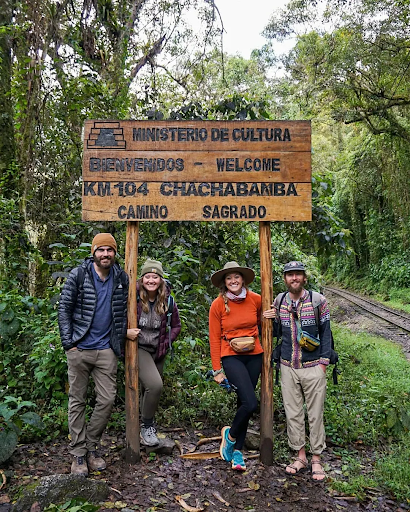
Two days sounds almost too easy, right? Most people picture the Inca Trail as a four-day adventure through mountain passes and cloud forest. So when they see a two-day version, the first reaction is usually skepticism. Like maybe it’s a watered-down option for travelers who couldn’t commit to the full thing. That’s not what this is. The Inca Trail 2-day trek is a legitimate trek.
It’s shorter, yes, but it ends the same way the four-day does: walking through the Sun Gate as Machu Picchu appears below you. That moment doesn’t change based on how many days you spent getting there. Still, there are real trade-offs. And if you’re trying to decide whether the Inca Trail 2-day trek is enough, you deserve an honest answer.
What does the route actually look like
You take an early train from Cusco to kilometer 104, where the 2-day route begins. From there, you hike up through cloud forest to Wiñay Wayna, one of the most striking Inca sites on the entire trail. It gets less attention than Machu Picchu, which is a shame, because the terracing and stonework there are genuinely worth stopping for.
You spend the night at a lodge near Wiñay Wayna. Then on day two, you wake before dawn, start hiking, and time your arrival at the Sun Gate for sunrise over Machu Picchu. After that, you descend into the citadel for a guided tour.
The total hiking distance is around 14 kilometers. That’s not a casual walk. The trail gains real elevation on day one, and the pre-dawn push on day two is no joke, especially at altitude.
Is it physically demanding?
Yes. Perhaps more than most people expect. Anyone who books this thinking it’s a gentle stroll usually finds out otherwise around the two-hour mark on day one. The altitude hits harder than the distance. Cusco sits at 3,400 meters. The trail climbs higher. If you haven’t spent at least two days acclimatizing in Cusco before you start, the hike will punish you for it.
This is probably the biggest mistake first-time trekkers make. They fly into Cusco, spend one night, and assume they’re fine. They’re often not.
Spend at least two full days in Cusco before the trek. Walk around, drink coca tea, take it slow. Your legs will thank you on day one.
What do you miss by choosing two days over four?
The original four-day trek begins from 82 km and runs for roughly 43 km overall. This route includes the highest peak of the trail, called Dead Woman’s Pass, with an altitude of 4,215 meters. This four-day hike involves multiple ruins of the Incas. It starts with an alpine landscape and then moves through the cloud forest and finally ends up in a jungle landscape.
The 2-day version skips all of that. You join the trail at its final section, walking the same path as four-day trekkers who started two days ahead of you. You don’t get the full arc of the route, and some people feel that absence when they get home and look back on it.
If you’ve always imagined yourself arriving at the Sun Gate after four hard days on the trail, the 2-day version might leave you with a quiet sense of “what if.” That feeling is worth thinking about before you book.
On the other hand, two days works well for a specific type of traveler.
If you have limited time in Peru and Machu Picchu is one stop among several, two days makes sense. It still puts you on the Inca Trail. It still ends at the Sun Gate. And it still gives you something most Machu Picchu visitors never experience: arriving on foot through ancient ruins rather than riding a bus up from Aguas Calientes.
That alone separates the 2-day trek from a standard day tour. You earn the arrival. That part is real.
Permits matter too
The Inca Trail has a strict daily permit limit. The 4-day route is heavily restricted and books out months in advance, sometimes six months or more. The 2-day route has its own quota, but availability is generally better.
So, are two days too short or just right?
It depends on what you want from the experience. If you want every kilometer, every mountain pass, and every campsite under the stars, two days will feel incomplete. Book the four-day route and plan well in advance.
If you want to walk into Machu Picchu through the Sun Gate, see Wiñay Wayna up close, and do it within a tight travel window, two days is genuinely enough. You won’t feel cheated. You might wish you’d had more time in Cusco beforehand, but the trek itself will deliver.
When you’re ready to figure out which option fits your trip, send Adrian a message on WhatsApp. He’ll look at your dates, your fitness level, and what you’re hoping to get from the experience, then help you choose the route that makes the most sense for you.

