Introduction
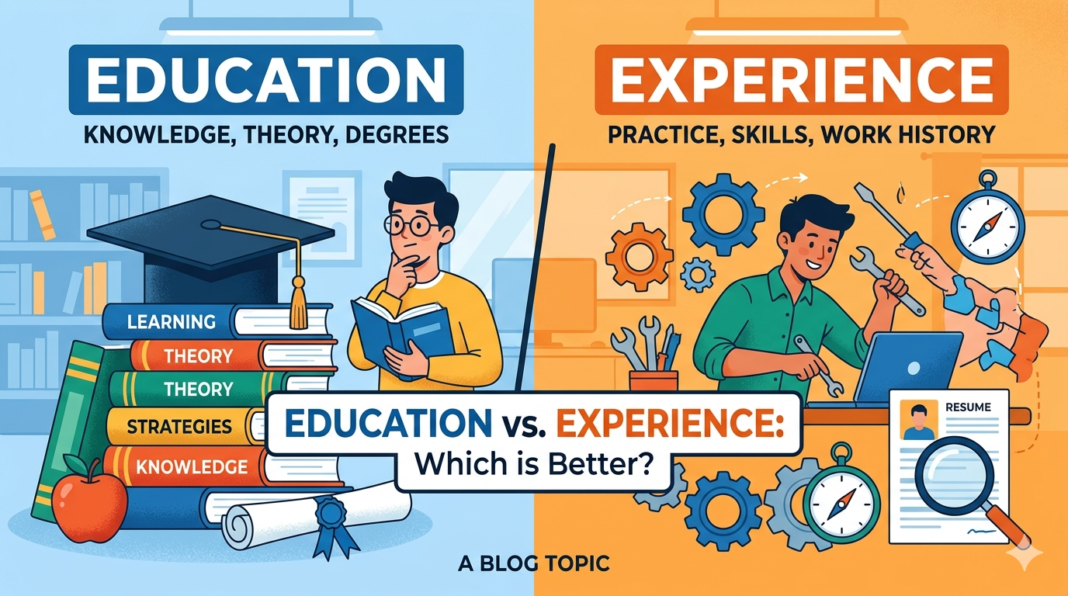
In the contemporary job market, the debate between education and experience has garnered significant attention. Both education and professional experience play critical roles in shaping an individual’s career trajectory, influencing their skill set, and determining their attractiveness to potential employers. Education often provides foundational knowledge and theoretical understanding, whereas experience offers practical application and real-world insights. This dynamic interplay raises important questions about which aspect holds greater value in different contexts.
Education is frequently seen as a formal process that equips individuals with essential knowledge and qualifications. Many occupations, particularly in fields such as medicine, law, and academia, require formal education credentials as prerequisites. These credentials validate an individual’s expertise and can serve as a ticket to entry-level positions. On the other hand, experience encompasses hands-on skills acquired through work, internships, or vocational training. It allows individuals to navigate real-world challenges and gain practical problem-solving abilities, which may not always be covered in academic settings.
The relative importance of education versus experience may vary by industry, job role, and even organizational culture. Some employers prioritize candidates with extensive experience, believing it translates to immediate readiness for the job. Conversely, others may value the latest knowledge and theories that formal education provides, particularly in rapidly evolving fields such as technology and science. Understanding the strengths and limitations of both education and experience is vital, as it enables individuals to make informed decisions about their career paths. In evaluating personal goals, job market trends, and specific industry demands, one must consider how education and experience can complement each other to enhance overall employability.
Defining Education and Experience
In the discourse surrounding personal and professional development, the terms education and experience hold significant importance. Each concept contributes uniquely to an individual’s skill set, knowledge base, and overall competency.
Education primarily refers to the structured learning that individuals undergo, often culminating in formal qualifications such as degrees, diplomas, and certifications. This form of learning typically occurs within educational institutions, where curricula are designed to impart knowledge across various subjects. Education can be categorized into formal, which includes traditional schooling, and informal, encompassing alternative educational paths like online courses, workshops, or self-directed learning. The key element of education is its systematic approach to knowledge acquisition, where theories, principles, and concepts are systematically taught.
On the other hand, experience pertains to the practical understanding and abilities gained through direct involvement in activities or jobs over time. This includes both professional experience, acquired through work placements, internships, or job roles, and personal experience, which encompasses life situations that contribute to one’s skills and competencies. Experience is often valued for its practicality and the real-world application of knowledge, as it reflects an individual’s ability to apply learned concepts in various contexts.
In summary, the definitions of education and experience are critical for understanding their respective roles in personal growth. While education lays the foundation of knowledge, experience allows for its application and mastery. Both elements are intertwined and essential in shaping an individual’s capabilities and pathways to success.
The Case for Education
Formal education serves as a critical foundation for individuals seeking to establish their careers in an increasingly competitive job market. A structured educational pathway equips students with essential knowledge in their field of study, fostering a deep understanding of core concepts and principles. This foundational knowledge not only enhances the learner’s comprehension but also encourages the development of critical thinking skills, allowing individuals to approach problems systematically and creatively.
Moreover, obtaining a degree or relevant qualification often enhances employability by providing a tangible credential that demonstrates a level of expertise and commitment to the field. Employers frequently prioritize candidates with formal education, as it indicates a dedicated investment in learning and skill acquisition. This preference for educated candidates reflects a broader recognition of the value that structured learning brings to the workplace.
In addition to improving job prospects, formal education serves as a gateway to invaluable networking opportunities. Through educational institutions, students have the chance to connect with experienced professionals, industry leaders, and fellow peers, which may lead to job offers and collaborative endeavors. Networking can be instrumental in career advancement and can provide insights into industry trends, thereby offering a competitive edge.
Furthermore, an education’s impact on potential salary prospects cannot be overlooked. Statistics consistently show that individuals with higher educational qualifications tend to earn significantly more over their lifetimes compared to those without such credentials. This correlation between education and income highlights the economic benefits of investing in education.
The Case for Experience
Experience offers invaluable benefits that often surpass formal education, particularly in rapidly evolving fields. It provides individuals with a profound understanding of their industry, enhancing problem-solving abilities and practical knowledge. Through hands-on work, employees cultivate skills that are not taught in the classroom, enabling them to navigate real-world challenges more effectively.
One of the key advantages of experience is the emphasis on practical skills. Unlike theoretical knowledge, which can sometimes seem abstract, practical skills are developed through direct engagement with day-to-day operations. This exposure equips professionals with the tools necessary to contribute meaningfully to their organizations from the outset. In contrast, educational settings may lack the immediacy and relevance of real-world applications, making it difficult for graduates to adapt quickly when entering the workforce.
Moreover, mentorship is an essential component of experiential learning. Working alongside seasoned professionals allows less experienced individuals to learn best practices, receive guidance, and develop their capabilities in an organic manner. This relationship fosters growth, as mentees can seek advice on not only technical matters but also soft skills, which are often considered as crucial for career advancement.
Additionally, experience enhances adaptability—a vital trait in today’s dynamic labor market. Those who have faced diverse situations are usually more prepared to pivot when necessary, as they possess a wealth of practical insights. They understand how to modify their approaches based on contextual factors, a quality that cannot be easily replaced by theoretical knowledge alone.
In conclusion, while education provides foundational knowledge and theoretical frameworks, experience enriches individuals with practical insights, mentorship opportunities, and the development of essential soft skills. Together, these aspects create a strong case for prioritizing experience as a means of professional growth and success.
Current Job Market Trends
The current job market reflects a dynamic landscape influenced by various factors including technological advancement, economic shifts, and changes in employer expectations. Recent studies reveal a growing trend whereby many employers are prioritizing practical experience over formal education. For instance, a survey conducted by the World Economic Forum in 2022 indicated that nearly 70% of companies are increasingly valuing job applicants with relevant work experience, regardless of their academic qualifications.
This shift is particularly evident in industries such as technology, hospitality, and trade. In the tech sector, for example, the demand for skilled professionals capable of navigating complex coding and software development requirements often overshadows the value placed on traditional degrees. Consequently, many organizations are leaning towards hiring candidates who demonstrate a proven track record of hands-on experience in their respective fields.
In addition, the rise of vocational training and online certification programs has contributed to the trend favoring experience. These alternatives provide individuals with practical skills that are often more directly applicable to job roles than some conventional university programs. According to the U.S. Bureau of Labor Statistics, jobs in sectors like healthcare and information technology are projected to grow significantly, providing ample opportunities for those with relevant experience, even if they lack a formal degree.
Moreover, the emphasis on experience is also being shaped by the rapid pace of change in the job market. Employers are keen on adaptability and practical skill sets that can directly impact productivity, leading to a more meritocratic approach in hiring practices. As companies continue to navigate an evolving economic environment, the debate between education and experience persists, showcasing the multifaceted nature of career preparation and workforce readiness.
Education and Experience in Different Industries
The debate between education and experience is particularly context-sensitive, varying significantly across industries. In the tech industry, for instance, practical experience and demonstrable skills often take precedence over formal educational qualifications. Companies tend to prioritize candidates who have a portfolio of work or relevant project experience, as the rapid evolution of technology requires adaptability and hands-on skills. This trend highlights a preference for learning through doing, where knowledge acquired from real-world scenarios can outweigh traditional degrees.
Conversely, in sectors such as healthcare and academia, formal education and credentials are paramount. Medical professionals are required to possess specific degrees and certifications that validate their knowledge and competence. Here, the importance of rigorous academic training cannot be overstated—healthcare relies heavily on established procedures and knowledge derived from extensive study. Likewise, academic positions often necessitate advanced degrees such as a Ph.D., underscoring the value of formal education in validating expertise within those fields.
Furthermore, industries like law also underscore the significance of educational credentials. Legal practitioners typically are expected to pass bar exams, which inherently require a formal education in law. This demonstrates a clear trend wherein certain professions mandate educational qualifications as essential prerequisites for practice. In such contexts, prior experience, while valuable, is often viewed as complementary to education rather than an alternative.
In conclusion, the balance between education and experience is a nuanced issue influenced by industry specifics. Understanding the expectations and requirements of each field can guide individuals in making informed decisions about their career paths, ensuring they align their qualifications with the norms of their chosen industry.
The Hybrid Approach: Combining Education and Experience
The debate between education and experience as the better route for personal and professional development is an ongoing discussion in many fields. However, adopting a hybrid approach that integrates both can yield transformative outcomes. By leveraging the theoretical foundations acquired through formal education alongside the insights gained through practical experiences, individuals can create a robust framework for success. This combination not only enhances skill sets but also prepares individuals to face real-world challenges more effectively.
One of the primary advantages of combining education and experience lies in the application of knowledge. Formal education provides essential theories, principles, and methodologies that guide individuals in their respective disciplines. However, without the application of this knowledge in professional settings, its value may diminish. Conversely, experiences in the workforce can reinforce and contextualize academic learning, making it more relevant and impactful. An individual who has grasped complex concepts in the classroom and later applied them in a workplace scenario is likely to gain a deeper understanding of the subject matter.
To effectively balance both elements, individuals can pursue opportunities such as internships, co-op programs, or part-time roles that complement their academic pursuits. Engaging in projects that allow the practical application of coursework can also bridge the gap between theory and practice. Furthermore, continuous professional development, including workshops and training sessions, can enrich both educational background and experiential knowledge.
Ultimately, a hybrid approach cultivates versatility, allowing professionals to navigate complexities with competence and confidence. This balance not only enriches an individual’s resume but also builds a more well-rounded professional who is prepared for various challenges in their respective fields.
Personal Development and Lifelong Learning
In today’s dynamic world, the importance of personal development cannot be understated. The shifting job market and rapid technological advancements necessitate an adaptable workforce capable of continuous learning. This notion aligns with the concept of lifelong learning, which emphasizes that education should not conclude upon graduation but rather extend throughout an individual’s career and personal life.
Lifelong learning encompasses various forms of education, including formal, informal, and experiential learning. Formal education, such as obtaining degrees or certifications, equips individuals with foundational knowledge and skills specific to their fields. However, as industries evolve and new technologies emerge, these qualifications can become outdated. Hence, gaining practical experience through internships, workshops, and real-life applications becomes increasingly vital.
Moreover, personal development through lifelong learning extends beyond traditional educational paths. It involves cultivating soft skills, such as adaptability, communication, and critical thinking, which are essential in navigating complex work environments. Engaging in new experiences, whether through volunteering, travel, or hobbies, fosters a deeper understanding of diverse perspectives and enhances interpersonal skills. These experiences also contribute to personal growth, helping individuals to reflect on their strengths and weaknesses, thus guiding future development initiatives.
In essence, the synergy between education and experience creates a robust framework for personal development. As individuals pursue a balanced approach to lifelong learning, they increase their employability and create opportunities for career advancement. The importance of remaining both educated and experienced cannot be overstated in today’s competitive landscape, where the ability to adapt and learn continuously proves to be invaluable.
Conclusion
In reflecting upon the merits of education versus experience, it is clear that both elements play a critical role in shaping one’s career trajectory. Education provides foundational knowledge and theoretical frameworks that can enhance understanding in various fields, while experience offers practical insights and skills that are often not covered in academic settings. The benefits of formal education can lay the groundwork for specialized expertise, particularly in disciplines where rigorous training is paramount.
On the other hand, real-world experience enables individuals to apply their educational knowledge in practical situations, thereby enhancing their problem-solving capabilities and adaptability in dynamic environments. For many employers, demonstrable experience can serve as a testament to an applicant’s capabilities, often outweighing educational qualifications alone. The synthesis of both education and experience typically leads to a well-rounded individual, fully equipped to navigate the complexities of the modern workforce.
Ultimately, the decision regarding the emphasis on education or experience should be informed by individual career aspirations and goals. For some fields, advanced degrees may be essential, while others may prioritize hands-on experience. It is essential for professionals to assess their own journeys and determine how they can effectively leverage both education and experience to facilitate personal and professional growth. By understanding the unique advantages each dimension offers, individuals can make more informed choices that enhance their prospects for success.

