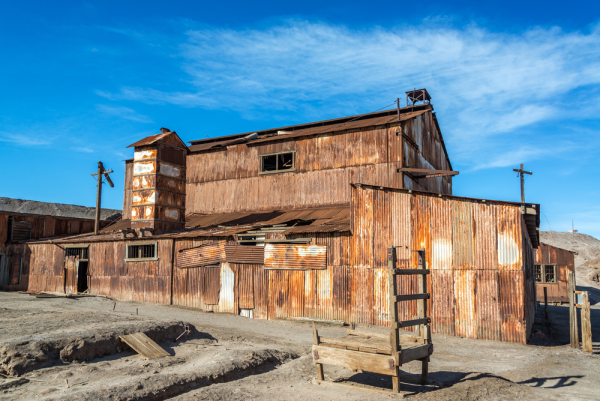
Take a walk through any major industrial city or coastal town, and you will notice a stark contrast in the built environment. On one side of the street, a ten-year-old chain-link fence or exposed steel beam is bleeding orange rust down the side of a concrete wall. On the other side, a massive power transmission tower or highway guardrail stands perfectly intact, sporting a dull, matte-gray finish despite having weathered identical rainstorms, snow, and salt for the last fifty years.
To the naked eye, steel is just steel. But this massive discrepancy in longevity is not an accident of nature; it is the result of a microscopic, highly deliberate battle against one of the most destructive forces on earth: oxidation.
Understanding why some structures decay while others endure requires looking past the physical bulk of the metal and exploring the volatile chemistry happening on its surface.
The Inevitable Enemy: Oxidation
To understand how to protect a building, you first have to understand why it wants to fall apart. Steel is primarily composed of iron. In nature, iron rarely exists in its pure, metallic state; it is usually found as iron ore (iron oxide), which is chemically stable.
When humans mine iron ore and smelt it into structural steel, we are essentially forcing the metal into an unnatural, highly energized state. From the moment that steel cools, it is desperately trying to return to its stable, natural form. All it needs is an electrolyte—like rainwater or humidity—and oxygen. When these elements meet the steel, an electrochemical reaction occurs, stripping electrons from the iron and creating iron oxide. We know this as rust.
Rust is insidious because it is expansive. As it forms, it flakes away, exposing fresh steel underneath to the elements, continuing the cycle until the structural integrity of the beam is completely compromised.
The Flaw of the “Barrier” Defense
Historically, humanity’s first line of defense against this decay was the barrier method: painting.
Painting a steel bridge or a commercial building seems logical. If you put a physical barrier between the steel and the moisture in the air, the steel cannot rust. The fatal flaw in this logic is that the barrier is fragile.
Paint dries, shrinks, and cracks under UV exposure. It gets scratched during installation, or chipped by flying debris. The moment a microscopic pinhole appears in a coat of paint, moisture enters. Because the rest of the moisture is trapped beneath the paint, the steel begins to rust from the inside out. By the time the paint finally bubbles and peels away, the structural damage is already severe. This is why painted infrastructure requires incredibly expensive, endless cycles of sandblasting and recoating.
The Metallurgical Shield
The structures that last a century do not rely on fragile paint; they rely on a fundamentally different chemical strategy known as cathodic protection.
Rather than just covering the steel, engineers alter its very surface by bonding it with zinc. This is not a superficial coating that simply sits on top of the metal. When steel is submerged into a kettle of molten zinc heated to roughly 840 degrees Fahrenheit, a rapid metallurgical reaction occurs. The iron in the steel reacts with the liquid zinc to form a series of tightly bonded zinc-iron alloy layers, topped with an outer layer of pure impact-resistant zinc.
This process transforms the surface of the beam into a biological-like shield. For large-scale construction, utilizing professional galvanizing services is often the deciding factor between a project that requires constant upkeep and one that stands resilient for generations.
The Magic of the “Sacrificial” Anode
The true genius of this zinc-iron alloy lies in how it behaves when it is damaged.
If a piece of treated steel is scratched deeply enough to expose the bare iron underneath, it does not begin to rust like painted steel. Because zinc is more electrochemically reactive than iron, the surrounding zinc will actually sacrifice its own electrons to protect the exposed steel. The zinc willingly oxidizes so the structural core does not have to. It acts as a sacrificial anode, physically “healing” the breach with a protective byproduct that prevents rust from taking hold.
The Economics of Longevity
This metallurgical miracle is not just a scientific curiosity; it is a massive economic lever.
In public works, urban development, and private construction, the initial cost of erecting a building is only a fraction of its total lifecycle cost. Structures that require constant maintenance slowly drain municipal and corporate budgets over decades. By contrast, a structure protected by a deeply bonded zinc alloy can easily survive 70 to 100 years in a corrosive environment without requiring a single hour of maintenance.
The next time you pass a massive steel structure that looks as solid today as it did when it was erected mid-century, you are not just looking at good architecture. You are looking at a masterclass in chemistry—a silent, ongoing war where a sacrificial metal gives its life to ensure the modern world remains standing.

