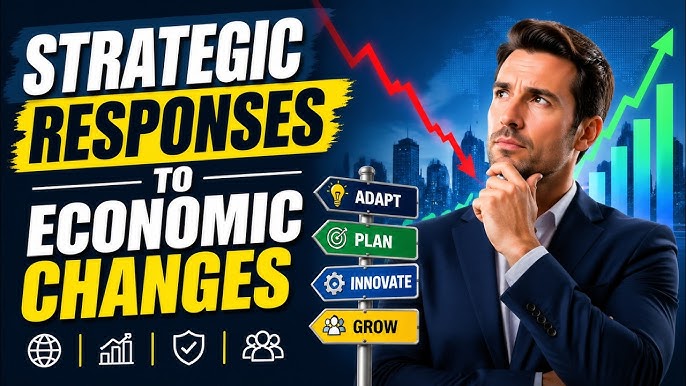
Understanding Economic Changes
Economic changes significantly influence business environments, comprising various phenomena such as recessions, booms, inflation, and shifts in consumer behavior. Each type of economic change presents unique challenges and opportunities that organizations must be equipped to navigate effectively.
A recession, characterized by a decline in economic activity, can lead to reduced consumer spending and decreased demand for goods and services. For businesses, this downturn often necessitates implementing cost-cutting measures, including layoffs or scaling back production. Understanding the indicators of a recession, such as falling consumer confidence and rising unemployment rates, can assist businesses in proactively adjusting their strategies to sustain operations during such periods.
Conversely, an economic boom typically indicates rapid growth and increased consumer spending. During such times, businesses may experience heightened demand, requiring them to scale operations swiftly. The ability to adapt to growing needs can differentiate successful companies from those that cannot respond effectively to changes in the market landscape.
Inflationary periods also present significant challenges for businesses, as rising prices can erode purchasing power. Companies may face increased costs for raw materials and labor, which can affect profit margins. In reaction to inflation, businesses might need to raise prices or seek more cost-efficient production methods, impacting how they operate in a competitive landscape.
Additionally, shifts in consumer behavior, often driven by changes in technology, preferences, or economic conditions, necessitate nimbleness from businesses. Understanding these behavioral changes allows companies to tailor their products and services effectively, ensuring they meet evolving consumer needs and maintaining their market relevance.
The Importance of Agility in Business
In today’s ever-evolving economic landscape, the ability of businesses to remain agile and adaptive is more critical than ever. Agility in business refers to the capacity to respond swiftly to changes in the market and the external environment, enabling companies to thrive amid uncertainty. Organizations that embrace flexibility can swiftly adjust their strategies, operations, and services to meet fluctuating demands and economic conditions.
For instance, during the 2008 financial crisis, companies like Netflix and Amazon showcased remarkable agility. While many businesses faltered, Netflix capitalized on the shift from traditional media consumption to streaming services, pivoting its business model to focus on on-demand content. Similarly, Amazon’s focus on e-commerce allowed it to rapidly scale its logistics and continue meeting consumer demands when brick-and-mortar retailers struggled. These examples exemplify how strategic agility can lead to not only survival but growth during economic downturns.
Moreover, the COVID-19 pandemic further underscores the significance of agility. Businesses that were quick to pivot their operations—such as restaurants that transitioned to delivery and takeout services or retailers that swiftly adapted their supply chains to prioritize online sales—demonstrated the importance of being nimble. Companies that employed technology to facilitate remote work were better equipped to navigate the disruptions caused by global lockdowns.
By fostering a culture of agility, organizations can enhance their resilience in the face of economic shifts. This involves embracing innovative practices, investing in technology, and empowering employees to make decisions quickly. Ultimately, the ability to adapt not only helps businesses mitigate risks but also opens up new opportunities for growth and development, ensuring long-term sustainability in unpredictable markets.
Analyzing Market Trends and Consumer Behavior
In an ever-changing economic landscape, understanding market trends and consumer behavior is paramount for businesses aiming to remain competitive. Employing effective analysis methods can help organizations identify shifts in market dynamics, ensuring their strategies are well-aligned with consumer needs. One fundamental approach is market research, which encompasses various techniques including qualitative and quantitative research methods. Qualitative research, such as focus groups and interviews, provides insights into consumer attitudes and preferences, while quantitative methods, such as surveys and statistical analysis, offer measurable data on market size and potential.
Surveys play a crucial role in gathering direct feedback from consumers. A well-structured survey can illuminate consumer perceptions, purchasing drivers, and preferred channels during economic fluctuations. Modern tools, such as online survey platforms, enable businesses to reach a wider audience efficiently, thus enhancing the depth and breadth of data collected. It is essential to ensure that surveys are designed with clarity and precision to capture meaningful insights that can guide decision-making.
Data analytics is another powerful tool for analyzing market trends and consumer behavior. By harnessing big data, businesses can track consumer interactions, spending habits, and emerging trends over time. Advanced analytics techniques, such as predictive analytics, allow businesses to forecast future trends based on historical data, enabling proactive adaptations to market changes. Integrating customer relationship management (CRM) systems with data analytics not only consolidates consumer data but also provides a comprehensive view of individual behaviors and preferences, thus facilitating personalized marketing strategies.
Ultimately, analyzing market trends and consumer behavior requires a multifaceted approach. By effectively utilizing market research, surveys, and data analytics, businesses can identify crucial shifts in the economic climate and consumer preferences, positioning themselves strategically to navigate challenges and seize opportunities as they arise.
Financial Strategies for Adaptation
In navigating the complexities of economic fluctuations, businesses must adopt sound financial strategies that enable them to remain resilient and competitive. One of the primary strategies is effective cost management. This involves analyzing and controlling expenditures to ensure that resources are allocated efficiently. To enhance cost management, businesses can implement practices such as regular financial reviews, budget adjustments, and the elimination of unnecessary expenses. By focusing on optimizing operational costs, organizations can improve their financial stability during challenging economic times.
Another crucial element is financial forecasting. Accurate forecasting allows businesses to anticipate potential economic shifts and make informed decisions ahead of time. By analyzing market trends, historical data, and economic indicators, companies can develop projections that inform various aspects of their operations, including inventory management and staffing levels. Incorporating various scenarios into forecasting models can also prepare businesses for both favorable and adverse conditions, thus ensuring a proactive rather than reactive approach to financial planning.
Diversifying revenue streams is a potent strategy for mitigating risks associated with economic changes. Relying on a single source of income can expose businesses to instability, particularly during downturns. By exploring new markets, developing innovative products, or reconfiguring service offerings, firms can create alternative revenue channels. This not only provides a buffer during economic uncertainty but also opens opportunities for growth and expansion. Implementing these financial strategies requires critical evaluation and continuous adaptation, making them vital components of a robust business strategy.
Innovating Products and Services
In the face of economic changes, businesses must prioritize innovation in their products and services to remain competitive and meet shifting consumer demands. Companies that successfully adapt often change their offerings, thereby addressing the evolving needs of their customer base. This process not only ensures relevance but also enhances their market position amid economic turbulence.
One prime example of successful innovation is Starbucks, which consistently adapts its menu to cater to consumer preferences. During economic downturns, the company introduced lower-priced products to attract cost-conscious customers, while also embracing seasonal and trendy beverages to create buzz and drive foot traffic. This strategic approach allowed Starbucks to maintain customer loyalty and even increase sales during challenging times.
Another noteworthy case is that of Dyson, known for its innovative vacuum cleaners and home appliances. In response to changing consumer priorities towards sustainability and efficiency, Dyson expanded its product line to include energy-efficient devices and eco-friendly vacuum cleaners. By prioritizing innovation and sustainability, Dyson successfully appealed to environmentally-conscious consumers and managed to maintain a strong market presence, even as economic conditions fluctuated.
Furthermore, companies can leverage technology to innovate their services. For instance, Peloton, a fitness equipment company, rapidly adapted its business model to focus on enlightening in-home fitness experiences during the COVID-19 pandemic. By offering live-streamed classes and a digital subscription model, Peloton not only retained its customer base but also attracted new members who sought at-home fitness solutions. This swift pivot in service delivery exemplifies how innovation in the face of economic challenges can yield remarkable results.
In conclusion, innovating products and services emerges as an essential strategy for businesses aiming to navigate economic changes effectively. By understanding consumer needs and making timely adaptations, companies can sustain growth and foster resilience in a constantly changing economic landscape.
Leveraging Technology for Adaptation
In the face of economic changes, businesses can significantly enhance their adaptability by embracing technology. Leveraging innovative technological solutions not only streamlines operations but also creates new avenues for reaching customers. Automation, for instance, is a powerful tool that allows organizations to maximize efficiency while reducing operational costs. By automating repetitive tasks, businesses can redirect their focus towards strategic initiatives, facilitating better decision-making and responsiveness to market shifts.
Additionally, the rise of remote work tools has revolutionized the traditional workplace setup. Platforms that enable remote collaboration, such as video conferencing software and project management systems, play a pivotal role in maintaining productivity during times of economic uncertainty. These technologies allow teams to work seamlessly, irrespective of geographical barriers, thus promoting business continuity. Adopting remote work options also opens the door to a larger talent pool, as organizations can hire skilled professionals from diverse locations.
E-commerce platforms have become indispensable for businesses seeking to survive and thrive amidst changing economic conditions. With consumer preferences increasingly gravitating towards online shopping, establishing a robust digital presence enables businesses to reach a wider audience and cater to evolving customer needs. By facilitating direct-to-consumer sales, e-commerce not only enhances revenue streams but also allows businesses to adapt quickly to changing market demands.
In summary, the integration of technology in various aspects of business operations is essential for adaptation to economic changes. From automation to remote work capabilities and e-commerce solutions, these technological advancements empower businesses to improve efficiency, maintain operational excellence, and ultimately enhance their competitive edge in the marketplace.
Enhancing Customer Engagement and Loyalty
In times of economic change, businesses face significant challenges that can impact their customer bases and overall profitability. Consequently, enhancing customer engagement and fostering loyalty become paramount for maintaining a competitive edge. Companies can adopt several strategic measures to strengthen their relationships with customers and promote sustained loyalty during these fluctuations.
One effective approach is to personalize customer interactions. By leveraging data analytics and customer insights, businesses can tailor their communications and offers to align with individual preferences and needs. This not only increases customer satisfaction but also creates a sense of connection, making clients feel valued. Personalized email campaigns, exclusive offers, and targeted social media interactions are practical examples of how businesses can use personalization to enhance customer engagement.
Additionally, providing exceptional customer service is crucial. During economic hardships, customers may have heightened expectations regarding support and service quality. Companies should invest in training their staff to ensure they are equipped to handle inquiries and complaints effectively. Businesses can further engage customers by soliciting feedback and demonstrating that their opinions matter, thus fostering a sense of partnership and community.
Moreover, deploying loyalty programs can significantly boost customer retention. Rewards systems that recognize repeat purchases or customer referrals not only incentivize ongoing engagement but also create an emotional bond between the brand and its customers. These programs can be enhanced with tiered memberships, special discounts, or exclusive access to new products, providing further motivation for customers to remain loyal.
Through these methods, firms can effectively enhance customer engagement and loyalty, ensuring their business remains resilient amidst economic changes. By prioritizing the customer experience and adapting strategies to meet fluctuating demands, businesses can secure a loyal customer base prepared to weather economic uncertainties together.
Collaborations and Partnerships
In times of economic change, businesses often face numerous challenges that can strain existing resources and hinder growth. One effective strategy to navigate these turbulent periods is through the establishment of collaborations and partnerships. By fostering relationships with other organizations, businesses can combine their strengths, share risks, and leverage complementary assets to adapt more successfully to the changing economic landscape.
Through strategic partnerships, companies can enhance their resource pool. For instance, by collaborating with another firm, businesses can access shared facilities, technology, or expertise that they might not have been able to afford independently. This pooling of resources can drive down operational costs, making it easier for both partners to weather economic downturns. Additionally, such collaborations can lead to improved efficiency, as companies may implement joint processes that streamline operations and reduce waste.
Further, partnerships can provide both parties with a safety net during uncertain times. By working together, businesses can mitigate individual risks related to market volatility. For example, if one partner faces a downturn, the other may be able to offer support through shared marketing initiatives or joint ventures, ensuring that both organizations remain viable and competitive. Moreover, these alliances can open avenues for innovation. Collaborative environments often stimulate creative ideas, bringing diverse perspectives that lead to novel solutions tailored to the current economic climate.
In conclusion, collaborations and partnerships present a multifaceted approach for businesses seeking to adapt to economic changes. By uniting forces, organizations can maximize their potential to thrive, driving progress and resilience amidst challenges and uncertainties.
Future-Proofing Your Business
In today’s rapidly changing economic landscape, future-proofing your business is essential for long-term success. A resilient business model must incorporate a long-term vision that is adaptable to market shifts. This means understanding not only the current economic climate but also anticipating potential changes on the horizon. Businesses should regularly conduct market analysis and stay informed about emerging trends that could impact their industry.
Continuous learning is another critical component in the quest for future readiness. Organizations should foster a culture of innovation, encouraging employees to develop new skills and embrace lifelong learning. This can take the form of training programs, workshops, or online courses that equip staff members with the tools to navigate economic shifts and enhance their capabilities. Networking with industry leaders and attending conferences can also provide valuable insights into best practices and skills that are becoming increasingly relevant.
Moreover, adaptation should be ingrained in the business strategy. Companies can implement agile practices that allow them to pivot quickly in response to unforeseen economic changes. This involves creating flexible processes that can be adjusted rapidly without compromising efficiency or service quality. Additionally, diversifying products or services can prove beneficial. When businesses offer a range of options, they are better positioned to meet changing consumer preferences and mitigate risks associated with economic downturns.
Ultimately, future-proofing is about developing a proactive mindset that embraces change rather than fearing it. By integrating a long-term vision, committing to continuous learning, and ensuring that adaptation remains at the forefront of business operations, organizations can build resilience and sustain growth in an unpredictable economic environment.

