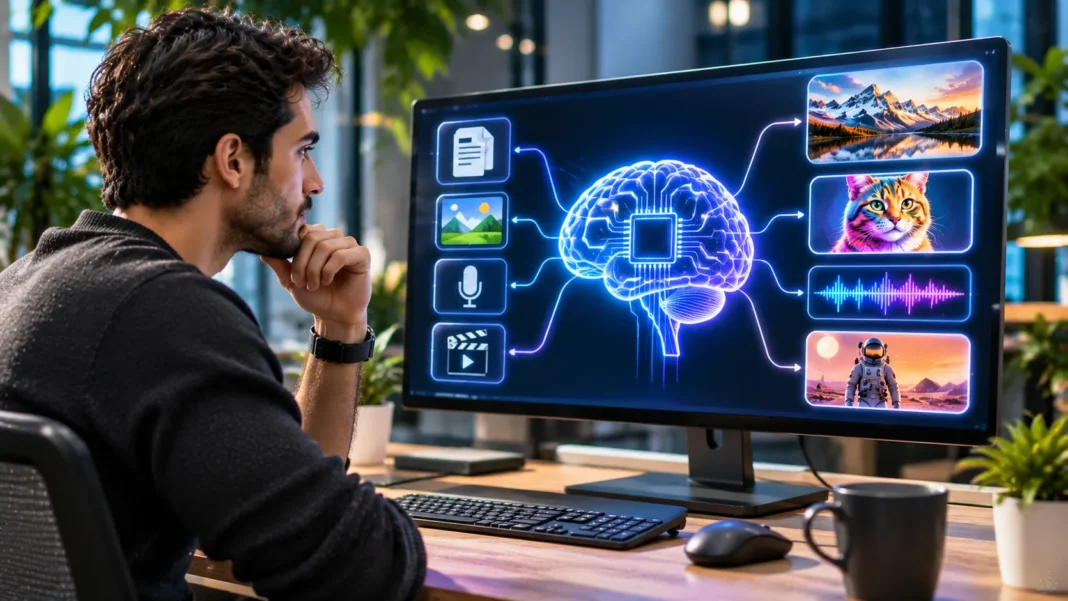
What Is Generative AI and How Does It Work?
Generative AI is a type of artificial intelligence that creates new content using patterns learned from existing information. It can generate text, images, videos, audio, and computer code based on instructions provided by users. Unlike traditional software that follows fixed rules, generative AI uses trained mathematical models to produce responses. Understanding how generative AI works helps explain its growing role in everyday technology.
The technology relies on machine learning, which allows computer systems to identify relationships within large datasets. During training, generative AI models learn statistical patterns rather than storing a simple collection of ready-made answers. These patterns help them generate outputs for unfamiliar requests. The results can appear creative, informative, or conversational, depending on the model and instructions.
For example, when you ask an AI chatbot to write a professional email, it processes your request and predicts a suitable sequence of words. An image generator works differently, producing visual content from descriptions or other inputs. Both systems use learned patterns to create outputs. However, their generated results may contain mistakes and require human review.
How Generative AI Learns From Training Data
Generative AI models learn through training processes involving large amounts of information. Depending on the system, training data may include text, images, audio recordings, or computer code. The model examines relationships within this information and adjusts its internal parameters. Over many training steps, these adjustments improve its ability to generate outputs resembling the patterns it has learned.
During language model training, a common objective involves predicting missing or subsequent tokens. A token can represent a word, part of a word, or another text element. The model compares predictions with expected results and updates its parameters to reduce errors. Repeating this process across many examples helps develop useful language-generation capabilities.
Training does not guarantee that a model understands information in the same way humans do. It may learn useful relationships while also absorbing inaccuracies, biases, or limitations from its data. The quality and diversity of training information influence model performance. Responsible development therefore involves careful data preparation, evaluation, and ongoing testing.
Understanding Neural Networks in Generative AI
Neural networks are mathematical systems inspired loosely by the organization of biological neurons. They consist of connected computational units that process information through layers of numerical operations. These networks learn by adjusting parameters during training. Modern generative AI systems often contain extremely large neural networks capable of identifying complex relationships in different types of data.
A neural network receives an input, processes it through multiple layers, and produces an output. During training, its predictions are compared with target information to calculate an error. An optimization process adjusts the network’s parameters to improve future predictions. This repeated learning process enables increasingly capable text, image, and other generation systems.
For example, a neural network trained on language can learn relationships between words, grammar, and context. When asked to explain a scientific concept, it uses these relationships to generate relevant sentences. However, a fluent explanation is not proof of factual accuracy. The model’s output still depends on its training, instructions, and available information.
How Large Language Models Generate Text
Large language models, commonly called LLMs, are generative AI systems designed to process and produce language. Many modern models use transformer architectures to handle relationships between tokens. These systems can generate explanations, summaries, stories, emails, and conversational responses. Their capabilities depend on model architecture, training methods, and the context provided during use.
When a user submits a prompt, the model converts the text into tokens. It then calculates probabilities for possible subsequent tokens based on the input and its learned parameters. A decoding process selects tokens according to the system’s generation settings. Repeating this process creates sentences that form the final response.
Consider asking an AI assistant to explain photosynthesis to a beginner. The model processes the request and generates an explanation using relevant language patterns. It may organize the answer into short paragraphs and include simple examples. However, it does not automatically verify every scientific statement. Important educational information should still be checked against reliable materials.
What Are Transformers in Generative AI?
Transformers are neural network architectures widely used in modern generative AI. They were developed to process relationships between elements in a sequence more effectively than many earlier approaches. Their attention mechanisms help models consider relevant parts of an input. Transformers are particularly important in language generation, although they also support image, audio, and multimodal applications.
The attention mechanism allows a model to calculate how strongly different tokens relate to one another. For example, understanding a sentence may require connecting a pronoun with a noun mentioned earlier. Attention helps the system represent these relationships mathematically. Multiple layers of processing enable the model to develop increasingly complex representations of language.
Transformers also support parallel processing during many training operations. This makes them suitable for learning from large datasets using specialized computing hardware. However, training capable models still requires substantial computational resources. Their effectiveness depends on architectural choices, data quality, optimization methods, and additional training techniques.
How Generative AI Understands User Prompts
A prompt is the instruction or information provided to a generative AI model. It may contain a question, task description, example, or detailed set of requirements. The model processes this input to generate an appropriate response. Clear prompts help establish the intended subject, format, audience, and level of detail.
For example, asking an AI tool to explain technology may produce a broad response. A more specific prompt requesting a beginner-friendly explanation of cloud computing with three examples provides useful direction. The additional details help the model produce more relevant content. Prompt quality can therefore influence how practical and accurate the final response becomes.
Prompts can also include documents, images, or other information when supported by the application. Multimodal systems process these inputs through suitable representations before generating outputs. However, a model may misunderstand ambiguous instructions or overlook important details. Reviewing results and refining prompts often improves their usefulness.
How Generative AI Creates Images
AI image generation uses models trained to learn relationships between visual patterns and descriptive information. These systems can create illustrations, realistic scenes, and other visual content from text prompts. Some also modify existing images according to user instructions. Their outputs depend on training data, model capabilities, and the details supplied in the request.
Diffusion models are widely used in modern image generation. During training, they learn to reverse a process that adds noise to images. When generating content, a model starts from a noisy representation and progressively develops a structured image. Text guidance helps influence the objects, setting, composition, and style of the result.
For example, a user might request a realistic image of a mountain cabin surrounded by snow. The AI processes the description and generates visual details that fit the requested scene. Changing the lighting or camera angle in the prompt can produce a different result. However, generated images may contain unrealistic details that require correction.
How Generative AI Produces Videos
Generative video AI creates moving visual content from text descriptions, images, or other video inputs. These systems must represent both visual appearance and changes across time. This makes video generation more complex than producing a single image. Models need to maintain reasonable consistency between frames while representing movement and changing scenes.
Some video generation systems use diffusion-based techniques, while others combine different modeling approaches. They learn patterns involving objects, environments, movement, and visual transitions. During generation, the model produces sequences of frames that form moving content. The quality depends on training, computational resources, and the complexity of the requested scene.
For example, a video model might generate a short scene showing waves moving toward a sandy beach. It must create suitable water movement while keeping the surrounding environment reasonably consistent. More complicated scenes involving several moving objects can be challenging. Generated videos may contain visual inconsistencies and should be reviewed before publication.
How Generative AI Creates Speech and Audio
Audio generation AI produces sound using patterns learned from recordings and other training information. Depending on the model, it can generate speech, music, sound effects, or different audio styles. Text-to-speech systems convert written words into spoken output. These technologies are useful for accessibility, education, media production, and various communication applications.
Modern speech generation systems often use neural networks to represent acoustic features and produce audio waveforms. Some models also support different speaking styles or languages. Their output quality depends on pronunciation, context, training, and synthesis methods. Generated voices may sound natural, but certain words or emotional expressions can still be inaccurate.
For example, an educational application can convert written lesson notes into spoken explanations. This may help learners access information while reading or listening. However, synthetic speech should be used responsibly, especially when imitating recognizable voices. Appropriate consent and clear communication help reduce risks involving misleading or unauthorized audio content.
How Generative AI Writes Computer Code
Generative AI coding assistants use models trained on programming-related information. They can suggest functions, explain errors, generate documentation, and help developers understand unfamiliar code. These systems identify relationships between programming instructions and common coding patterns. Their suggestions may improve productivity, but generated code still requires careful technical review.
When a developer requests a function, the model processes the instructions and predicts suitable programming tokens. It may generate code in languages such as Python, JavaScript, or Java. The output can include variable definitions, logic, and comments. However, the model may misunderstand requirements or introduce incorrect assumptions.
For example, a developer could ask for a Python function that organizes customer records alphabetically. The AI may produce a suitable implementation and explain its operation. The developer should test the function with normal and unusual inputs. Security checks and code review remain important because plausible-looking code may contain hidden problems.
Generative AI Examples in Everyday Life
Generative AI appears in many everyday digital tools. Writing assistants can improve sentence clarity, suggest email responses, and summarize long documents. AI chatbots provide conversational explanations and help users brainstorm ideas. These applications support routine activities by generating content based on instructions and available context.
Students may use generative AI to practice difficult concepts or create revision questions. Professionals may use it to prepare meeting summaries and draft presentations. Creative users can experiment with image generation or storytelling. The same underlying technology can therefore support different activities depending on the application and the user’s goals.
However, everyday convenience should not replace careful evaluation. AI-generated summaries may omit important details, while written explanations may contain inaccurate claims. Users should review content before sharing it or using it for important decisions. Responsible use means understanding when human expertise or independent verification is necessary.
How Generative AI Works in Marketing
Marketing teams use generative AI to support content planning, campaign development, and communication tasks. AI systems can draft advertisements, social media captions, product descriptions, and email messages. These outputs can provide starting points for further editing. Their usefulness depends on accurate audience information, brand guidelines, and thoughtful human review.
Search engine optimization is another common application. SEO professionals can use AI to organize keyword themes, develop content outlines, and explore search intent. They may also generate draft meta descriptions or improve existing website copy. However, AI-generated content should be accurate, original, helpful, and relevant to readers rather than produced solely for search rankings.
For example, a small business might ask an AI assistant to suggest blog topics for its services. The model could generate ideas based on the information provided. A marketing professional can then evaluate those topics using audience research and business priorities. This combination creates a more reliable content strategy than publishing unreviewed AI suggestions.
How Generative AI Supports Customer Service
Generative AI can help customer service teams draft responses and organize support information. It can answer common questions, summarize customer messages, and suggest troubleshooting steps. Some systems connect to approved company knowledge bases to retrieve relevant details. This combination can help support teams respond more efficiently to routine inquiries.
For example, a customer might ask how to reset an account password. An AI assistant connected to current support documentation could explain the approved recovery process. If the issue becomes complicated, the system can direct the customer toward human support. Clear escalation procedures are important when automated responses cannot resolve a problem.
Customer service applications must also protect personal information and avoid misleading statements. AI systems should not invent refund approvals, account changes, or completed actions. Businesses need appropriate monitoring and quality controls to identify errors. Responsible implementation helps maintain customer trust while improving access to useful support information.
How Generative AI Uses Retrieval-Augmented Generation
Retrieval-augmented generation, often called RAG, combines a generative model with a system that retrieves relevant information. Instead of relying entirely on training knowledge, the application searches an approved information source. Retrieved material is then provided as additional context for the model. This approach can improve answers when information is specialized or changes frequently.
A typical RAG system includes documents, a retrieval mechanism, and a language model. The system identifies information relevant to the user’s question and adds it to the prompt. The model uses this context to produce a response. However, the accuracy of the answer still depends on retrieval quality and the model’s interpretation.
For example, a company might create an AI assistant that answers questions about internal workplace policies. The system could retrieve relevant policy documents before generating an explanation. Employees would receive responses based on approved information rather than general assumptions. Source verification remains important because retrieved content can be incomplete, outdated, or misunderstood.
Why Generative AI Sometimes Makes Mistakes
Generative AI models can generate incorrect information because they learn statistical relationships rather than independently verifying every statement. Their primary generation process may produce language that appears reasonable without being factually supported. This problem is commonly called hallucination. It can occur even when a response sounds confident and well organized.
For example, a language model may provide an incorrect historical date or invent a reference to support an explanation. These mistakes can result from training limitations, insufficient context, or unreliable generation patterns. More detailed prompts may reduce certain errors but cannot eliminate them. Independent verification is necessary for important factual claims.
AI errors can also occur in generated images, videos, and code. Visual systems may create inconsistent objects, while coding assistants may introduce logical mistakes. Understanding these limitations helps users approach AI outputs realistically. Appropriate testing, fact-checking, and professional review remain important parts of responsible technology use.
What Makes Generative AI Different From Search Engines?
Search engines primarily help users locate information from indexed sources. They typically provide links, snippets, and other results connected to relevant webpages. Generative AI systems produce responses by generating new content based on learned patterns and available context. This creates a different experience from browsing a list of search results.
For example, a search engine may display several articles explaining renewable energy. A generative AI assistant can produce a customized explanation using the user’s requested level of detail. However, the generated answer may not include reliable sources unless the system has appropriate retrieval capabilities. This distinction matters when accuracy and freshness are important.
Modern search products increasingly combine retrieval with generative AI features. Some AI assistants also search external information sources before preparing responses. These developments create overlapping capabilities between the two technologies. Users should understand whether an answer comes from retrieved evidence, model-generated knowledge, or a combination of both.
Benefits of Understanding How Generative AI Works
Understanding generative AI helps people use the technology more effectively. Users who know that models learn patterns can develop realistic expectations about their capabilities. This knowledge also explains why prompts, context, and verification matter. Better understanding can reduce confusion when an AI system produces unexpected or inaccurate results.
Businesses benefit from understanding the technology before implementing it in daily operations. Leaders can identify suitable applications and recognize tasks that require additional oversight. This prevents unrealistic assumptions about complete automation. It also helps organizations evaluate whether generative AI offers measurable improvements in productivity or service quality.
Knowledge of generative AI can also support responsible decision-making. Users become more aware of privacy concerns, biased outputs, and reliability limitations. They can choose suitable tools and establish appropriate review procedures. Understanding the underlying process encourages practical use rather than depending entirely on impressive demonstrations or marketing claims.
Limitations and Challenges of Generative AI
One important limitation of generative AI is its dependence on training data and system design. Models may struggle with unfamiliar situations, ambiguous instructions, or highly specialized knowledge. Their responses can contain inaccuracies even when the wording appears convincing. These limitations make human review essential for tasks requiring dependable information.
Another challenge involves computational cost and resource requirements. Training large AI models can require substantial processing power, electricity, and specialized hardware. Running these models also consumes resources, particularly for complex image and video generation. Organizations must consider operational costs alongside the potential benefits of adopting generative technology.
Privacy, security, and copyright concerns create additional challenges. Sensitive information may be exposed if users share it through unsuitable systems. Generated content may also raise questions about originality and ownership. Responsible AI use requires clear data protection rules, appropriate permissions, and careful evaluation of generated materials.
How to Start Using Generative AI Effectively
Beginners can start using generative AI with straightforward tasks such as brainstorming, summarizing personal notes, or explaining general concepts. These activities provide opportunities to understand how prompts affect responses. Starting with familiar topics also makes errors easier to recognize. A gradual approach helps build confidence without relying on AI for important decisions immediately.
Choose tools that match your intended activities. Language models are useful for writing and explanations, while image generators support visual content creation. Coding assistants help with programming-related work. Before entering sensitive information, review privacy settings and understand how the application handles user data.
Develop a routine of checking outputs and improving instructions. If a response lacks detail, provide additional context and request a clearer explanation. Verify important claims through reliable sources and test generated code before using it. These habits can improve productivity while maintaining appropriate control over the final results.
Conclusion
Generative AI works by learning patterns from training data and using mathematical models to produce new content. Neural networks, transformers, and diffusion models support many modern applications. These technologies enable AI systems to generate text, images, videos, audio, and computer code. Understanding their basic operation makes the technology easier to evaluate and use.
Real-world examples demonstrate how generative AI supports writing, marketing, software development, education, and customer service. Different models use different methods to create their outputs. However, generated content may contain errors, misleading information, or unsuitable assumptions. Human review remains essential whenever reliability and accuracy are important.
Learning how generative AI works provides a useful foundation for exploring its practical applications. Clear prompts, suitable tools, and careful verification can improve the quality of results. Users should also consider privacy, security, and ethical responsibilities. With informed use, generative AI can become a valuable assistant for many creative and professional tasks.
Frequently Asked Questions
How does generative AI work in simple terms?
Generative AI learns patterns from large datasets using machine learning models. When users provide instructions, it applies those learned patterns to generate new text, images, audio, videos, or other content.
What is an example of how generative AI works?
An AI chatbot generating an email is a common example. It processes the user’s instructions and predicts a suitable sequence of words to create a complete message based on learned language patterns.
Does generative AI copy information from its training data?
Generative AI generally creates outputs using patterns learned during training rather than simply copying complete examples. However, models can sometimes reproduce memorized material, making appropriate review and copyright awareness important.
What technology powers generative AI?
Generative AI commonly uses neural networks, machine learning algorithms, transformer architectures, and diffusion models. Different technologies support different tasks, including language generation, image creation, and audio synthesis.
Why does generative AI sometimes give wrong answers?
Generative AI predicts outputs from learned patterns and does not automatically verify every fact. Insufficient context, training limitations, and model behavior can produce inaccurate or invented information, even when responses sound convincing.

