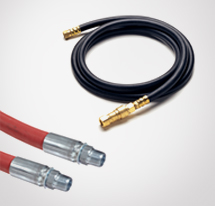
A flexible hose looks simple enough from the outside. Inside, it carries pressure, heat, chemicals, or steam that can cause serious damage if the wall fails. That is why choosing a flexible hose manufacturer rarely sits with one person. Engineers want safety. Finance wants a good price. Plant managers want delivery on time. Each one pulls in a slightly different direction.
Picking the wrong flexible hose manufacturer costs more than money. A burst hose on a chemical line can shut a unit for days. A failed steam connection has injured workers across factories. A non-compliant assembly can fail an audit and freeze a whole shipment at the port. The right questions, asked early, save all of that.
Here are the ones worth putting on the table before signing anything.
What standards do your hoses meet, and can you prove it?
Ask for certification numbers. Not promises. Hoses for hydraulic use should meet ISO 18752 or SAE J517. Steam hoses follow BS EN ISO 6134. Food-grade hoses fall under the FDA and EU 1935/2004 rules. Each industry has its own benchmarks.
A serious manufacturer sends the certificates without hesitation. If someone hedges or forwards a generic ISO 9001 page, that is a red flag. ISO 9001 covers the process, not the hose itself. The two get confused often, and sometimes deliberately.
Where do your raw materials come from?
The rubber, the wire reinforcement, the lining, all of it matters. A cheap inner tube from an unknown source can swell, crack, or contaminate the fluid running through it. Ask for material data sheets. Ask which mills supply the steel braid. Ask if the polymer batches are tested on arrival, or just accepted on paper.
You may not get every answer. A reluctant one tells you something, too.
How do you test before shipping?
Pressure testing is the bare minimum. Burst tests, impulse tests, and bend radius checks separate a careful maker from a careless one. A hose rated at 350 bar working pressure should be tested well above that figure. Some firms run impulse cycles into the hundreds of thousands and keep the data for years.
Request the test reports for the batch you are buying. Not a sample from two years ago. The actual batch, with the date and reel number printed on it. If they cannot produce it within a day, perhaps the testing is less rigorous than the brochure suggests.
Can you handle custom specifications?
Off-the-shelf works for common applications. Specialised plants rarely run common applications. Maybe the line carries acid at 90 degrees Celsius. Maybe the bend space is tighter than any catalogue allows. Maybe the fitting needs to match an old French coupling that nobody makes any more.
Ask if the manufacturer will build the product as per your drawing. Ask how long it takes. Ask what the minimum order applies to. Some will say no and be honest about it. Others will say yes and disappoint you three months later when the assembly arrives wrong.
What happens if a hose fails?
This is the question most teams forget. Then they remember it at the worst possible moment, usually around 2 AM, with a leak spreading.
A good supplier has a clear protocol. Root analysis, replacement timelines, and documentation your insurance team can use. They keep records of every batch, every reel, every coupling crimped. If a failure happens, they can trace it back within hours, not weeks.
Ask how they handle a claim. The answer reveals more than any brochure.
What is your lead time, and how steady is the supply?
Lead time looks like a logistics question. It is also a stability question. A factory that quotes six weeks today and twelve weeks next month is hiding something. Maybe capacity issues. Maybe staff turnover. Maybe the raw material shortages have not been solved.
Ask for delivery records over the past year. Ask about backup capacity. Ask if they can hold safety stock for repeat orders. The answers tell you whether the relationship will survive a busy quarter or fall apart the moment things get tight.
Who else trusts you, and can we speak to them?
References still matter, even in 2026. Ask for clients in your industry. Ask to call them. A manufacturer with a steady work history will arrange the call within a day or two. Vague answers, no names, or only client logos pasted on a website are warning signs.
If you can, visit the plant. A clean, organised factory floor with proper testing rigs tells you more than any sales pitch ever will. A messy one tells you something, too.
A short note before closing the file
Procurement teams sometimes treat hose buying like buying bolts. Cheaper is better, faster is fine, paperwork is paperwork. Then a line shuts down at 3 AM, and the cost lands on the same procurement file, multiplied tenfold.
Asking the right questions early avoids that 3 AM call. The questions above will not make every decision easy. Some answers will surprise you. Some will confirm what your engineers already suspect. Yet asking them changes the tone of the conversation. Suddenly, the manufacturer knows you are paying attention. And makers who know you are paying attention tend to send their better work.
That is worth the half hour it takes to write the questions down.

