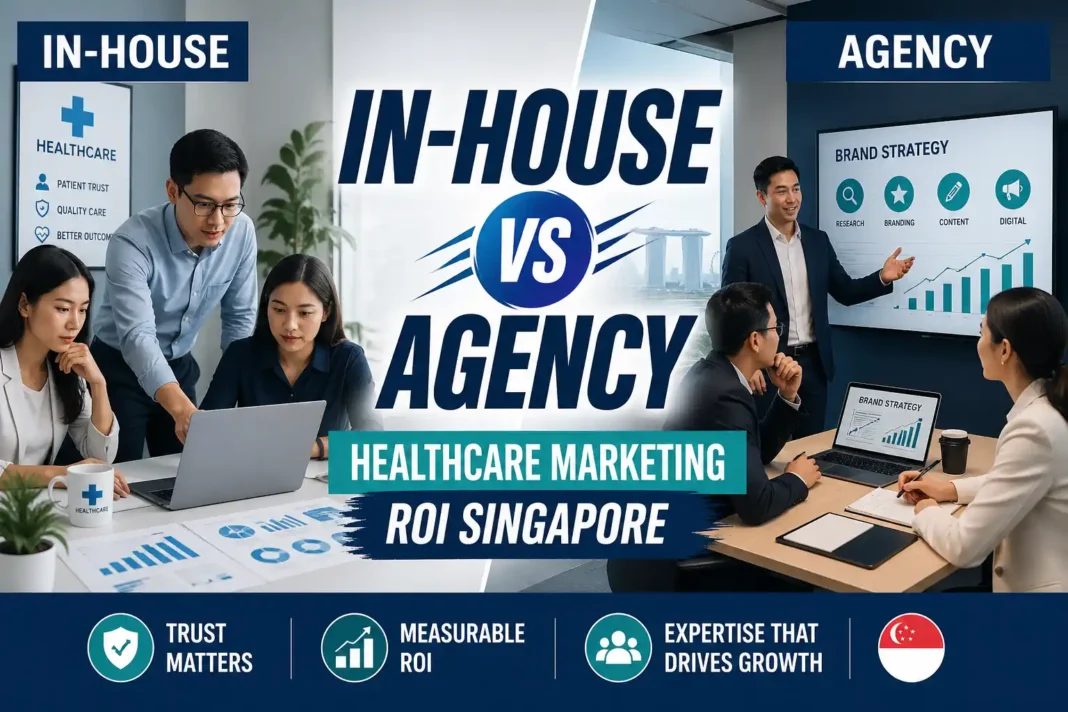
Healthcare organisations in Singapore are operating in an increasingly competitive environment. Patients are more informed, regulatory expectations are more defined, and the decisions that institutions make around their public presence carry real weight. Whether it is a private specialist clinic expanding its patient base, a regional hospital refreshing its identity, or a healthcare group entering a new service segment, the question of how to manage marketing and branding is one that surfaces regularly at the leadership level.
The choice between building an in-house marketing team and engaging an external agency is not purely a cost question. It touches on capability, consistency, speed, and the ability to communicate credibly within a sector that demands both accuracy and trust. For healthcare decision-makers in Singapore, this is a structural decision with long-term implications, not an operational preference that can be easily reversed.
What Each Model Actually Involves
When healthcare organisations in Singapore evaluate how to approach their branding and marketing, they are often comparing two fundamentally different operating structures. An in-house team is built internally, staffed by permanent employees who are embedded within the organisation. An external agency — such as a corporate branding agency singapore — operates as a specialised external partner that brings dedicated expertise, creative capacity, and market perspective on a retainer or project basis.
The distinction matters because both models carry specific strengths and limitations that are not always visible at the point of decision. The in-house model centralises knowledge and gives leadership direct oversight. The agency model distributes that function to a team whose entire practice is built around brand strategy, positioning, and communication design.
In-House Teams: Structure and Expectations
An internal marketing team within a healthcare organisation typically consists of marketing executives, content writers, digital specialists, and occasionally a creative lead. These individuals are employed directly, which means they are available for daily coordination, can attend internal meetings, and have ongoing access to clinical staff, compliance teams, and leadership.
This proximity is genuinely useful. Internal teams can respond quickly to operational updates, coordinate with HR for employer branding, and align messaging with the institution’s internal values without needing extensive briefing. Over time, they develop institutional knowledge that is difficult to replicate externally.
However, building a full-function team capable of handling brand strategy, creative production, digital marketing, and healthcare-specific regulatory compliance is resource-intensive. The talent required for each of these disciplines is not easy to consolidate into a small team without compromise. In practice, many in-house healthcare marketing teams in Singapore end up handling tactical execution well but struggle with strategic brand development — particularly when the organisation needs to reposition, expand, or differentiate in a crowded market.
Agency Partnerships: Structure and Expectations
An external agency dedicated to healthcare or institutional branding operates as a specialist service provider. The team working on a client’s account will include strategists, creative directors, brand managers, and communication specialists who typically bring experience across multiple healthcare clients and sectors.
This cross-sector exposure is one of the agency model’s clearest advantages. Agencies that work regularly in healthcare branding understand how Singapore’s Ministry of Health guidelines intersect with communication standards, how patient trust is built through consistent visual and editorial identity, and how institutions should position themselves differently from commercial consumer brands. This understanding is not acquired quickly through in-house hiring — it accumulates through sustained practice across diverse client engagements.
The limitation is access. Agency teams are shared across clients, and the organisation does not have direct, daily control over timelines or resource allocation in the same way it would with internal staff. Communication requires structured briefing, and institutional knowledge must be transferred proactively rather than absorbed organically.
The ROI Calculation Is More Than Headcount vs. Fees
When leadership compares costs between the two models, the calculation often starts with salary versus agency retainer. But that framing misses several variables that significantly affect the actual return on investment over time.
An internal team requires more than salaries. There are costs associated with recruitment, onboarding, tools and software subscriptions, training, and the management overhead that comes with maintaining a specialist department. Beyond direct costs, there is the opportunity cost of time — specifically, the time that internal leadership spends managing a marketing function rather than directing clinical or operational priorities.
Output Quality and Brand Consistency Over Time
One of the more underappreciated factors in the ROI equation is brand consistency. Healthcare institutions depend heavily on how they are perceived — by patients, by referring physicians, by insurers, and by the general public. A fragmented brand identity, inconsistent messaging, or poorly positioned communications can erode trust in ways that are difficult to quantify but very real in their effects.
In-house teams, particularly those that are small or understaffed, often produce output that is functionally adequate but strategically inconsistent. This is not a reflection of individual capability — it is a structural reality. When a team is managing day-to-day requests, campaign execution, and administrative coordination simultaneously, the deeper work of brand positioning tends to be deferred.
External agencies with a defined healthcare specialisation bring a systematic approach to brand governance. They apply structured frameworks to ensure that every piece of communication — from a patient brochure to a digital campaign — aligns with the institution’s positioning. According to research published by the World Health Organization on health communication standards, consistency in how health information is presented directly affects public trust and patient engagement. This principle applies equally to institutional branding.
Scalability and Response to Strategic Change
Healthcare organisations in Singapore do not remain static. Mergers, new service launches, facility expansions, and shifts in patient demographics all require marketing and branding responses that vary in scale. An in-house team of fixed size has limited capacity to surge when strategic demands increase. Adding headcount takes time, and specialist freelancers introduced to fill gaps create their own coordination challenges.
An agency partner can scale its involvement in direct response to the project scope. When a healthcare group needs to rebrand a newly acquired clinic within a defined timeline, or develop a brand architecture that integrates two institutional identities, the agency model provides the concentrated expertise and bandwidth to execute without the structural delay of internal hiring.
Where In-House Teams Genuinely Outperform
The comparison is not one-sided. There are specific functions where an embedded internal team consistently delivers better outcomes than an external partner, and healthcare organisations that recognise this are better positioned to make a rational decision.
Internal teams perform particularly well in:
- Rapid content updates tied to clinical operations, such as service hours, appointment protocols, or public health advisories that require same-day publishing
- Internal communications — staff newsletters, HR-aligned messaging, and culture-building content that benefits from insider familiarity
- Ongoing social media moderation and community response, where tone and response time depend on day-to-day operational awareness
- Cross-departmental coordination, where marketing needs to work in close alignment with clinical, finance, and operations teams simultaneously
These are execution-layer functions where presence and proximity matter more than specialist expertise. An in-house team that owns this layer well creates genuine operational value for the organisation.
The Case for a Hybrid Approach in Complex Healthcare Environments
Many mid-sized and larger healthcare organisations in Singapore have moved toward a hybrid model that combines the responsiveness of an internal team with the strategic depth of an external agency. Under this structure, the internal team handles day-to-day execution, community management, and cross-departmental coordination, while the agency retains responsibility for brand governance, campaign strategy, visual identity, and positioning decisions.
This approach works when the relationship between the internal team and the agency is clearly defined. Without clear delineation of responsibilities, both parties can duplicate effort or, conversely, leave strategic gaps unaddressed.
Making the Hybrid Model Work in Practice
The organisations that manage hybrid models effectively tend to invest time upfront in establishing shared brand guidelines, communication protocols, and decision-making frameworks. The internal team is briefed on the brand standards developed by the agency, and the agency is given regular access to operational updates that might affect communication positioning.
This requires deliberate governance, not just good intentions. Regular review cycles, shared content calendars, and defined escalation pathways ensure that the two functions reinforce rather than undermine each other. Without this structure, the hybrid model can create more complexity than either alternative would alone.
Concluding Perspective: Matching the Model to Strategic Reality
The decision between an in-house team and an external branding agency in Singapore’s healthcare sector ultimately depends on what the organisation needs most at its current stage of development. There is no universally correct answer, but there is a wrong way to approach the question — and that is to treat it primarily as a cost-reduction exercise.
Organisations that are early in their brand development, undergoing repositioning, or entering new markets tend to extract more strategic value from a dedicated agency partnership. The concentrated expertise, structured methodology, and cross-sector experience that a specialist healthcare marketing agency singapore brings to the relationship are difficult to replicate through internal hiring within a reasonable timeframe or budget.
Organisations with stable, well-defined brand identities and primarily execution-focused marketing needs may find that a strong internal team, potentially supplemented by agency support on specific campaigns, delivers better day-to-day responsiveness and institutional alignment.
What the evidence from organisations that have made this decision thoughtfully suggests is that the quality of strategic brand management — not the quantity of marketing output — is the real driver of ROI in healthcare. An internal team that produces consistent volume but lacks strategic depth will not build the institutional trust that patients and referring professionals respond to. An agency relationship that is poorly briefed and disconnected from clinical reality will produce polished work that misses the mark.
The right structure is the one that places strategic brand decisions in the hands of people who understand both the healthcare sector and the specific institution’s positioning — whether those people sit inside the organisation or outside it.

