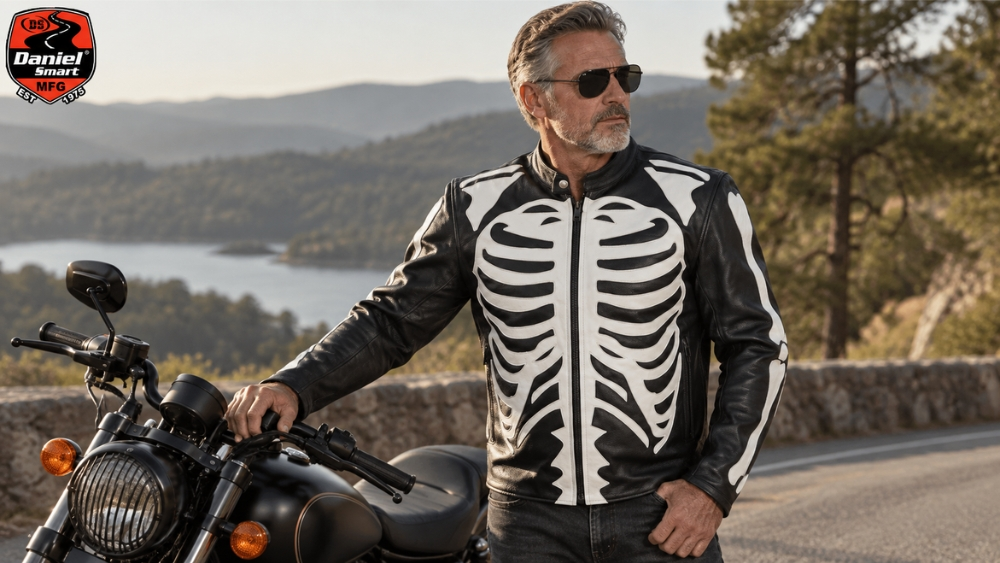
A motorcycle leather jacket for night riding should combine road-ready protection with features that make the rider easier to notice in low-light conditions. Reflective piping, retroreflective panels, contrasting sections, strategically placed reflective details, and a secure riding fit can all improve the jacket’s visibility after dark.
Black leather remains a popular choice among motorcycle riders, but dark colors naturally become harder to distinguish when surrounding light is limited. That does not mean riders need to stop wearing leather at night. Instead, they should pay attention to how the jacket uses reflective and contrasting elements.
Many men’s leather motorcycle jackets combine traditional motorcycle styling with functional details intended for riding. For riders who frequently travel after sunset, visibility should be considered alongside fit, ventilation, armor compatibility, and comfort.
Why Does Jacket Visibility Matter for Night Riding?
Night riding reduces the visual information available to everyone on the road.
Motorcycles already have a smaller visual profile than cars and trucks. Dark surroundings can make it harder for other road users to identify a rider’s position, movement, and shape.
A motorcycle jacket cannot replace headlights, taillights, turn signals, or attentive riding, but visible clothing can become one additional part of a rider’s overall presence.
Useful jacket visibility features help other road users notice:
- The rider’s upper body
- Shoulder width
- Arm movement
- Position on the motorcycle
- Movement from different angles
The goal is not simply making the jacket bright. Good visibility design places noticeable elements where they are likely to be seen.
What Are Reflective Features on a Motorcycle Jacket?
Reflective features are materials or details designed to return light toward its source.
When vehicle headlights shine on reflective material, that section of the jacket may appear significantly brighter than the surrounding leather.
Reflective details can be built into:
- Piping
- Stripes
- Logos
- Shoulder panels
- Sleeve sections
- Back panels
- Chest areas
During daylight, these features may appear relatively subtle.
At night, direct light can make them much more noticeable.
This allows a jacket to retain a traditional motorcycle appearance while adding low-light visibility.
What Is Retroreflective Material?
Retroreflective material is designed to return incoming light toward the direction it came from.
This is particularly relevant for night riding because vehicle headlights provide a direct source of light.
When headlights strike retroreflective sections on a rider’s jacket, those areas can become more noticeable to the driver.
The effectiveness of reflective material depends on:
- Placement
- Surface area
- Viewing angle
- Condition of the material
- Available light
- Distance
Reflective details should therefore be treated as a supporting visibility feature rather than a guarantee that another driver will see the rider.
Where Should Reflective Details Be Placed on a Motorcycle Jacket?
Placement matters.
Reflective material works best when it helps define the rider from several directions.
Useful locations can include:
Upper Back
The back is one of the most important areas because vehicles approaching from behind need to identify the rider.
Reflective strips or panels across the upper back can help create a visible horizontal shape.
Shoulders
Shoulder details can make the rider’s upper-body width easier to recognize.
They may also remain visible from slightly angled positions.
Sleeves
Reflective sections on the arms can become especially useful because the arms move while the rider operates controls or signals.
Chest
Front-facing reflective details may help increase visibility to vehicles approaching from the opposite direction or entering intersections.
Side Panels
Side visibility matters at intersections where another road user may see the rider from a perpendicular angle rather than directly ahead or behind.
A jacket that provides visibility from several directions is more useful than one with a single reflective logo on the back.
Is Reflective Piping Useful on Leather Motorcycle Jackets?
Yes.
Reflective piping is one of the easiest ways to add night visibility without dramatically changing the appearance of a leather jacket.
Piping can follow:
- Shoulder seams
- Sleeve lines
- Chest panels
- Back panels
Because it traces the shape of the jacket, it may help define the rider’s outline when illuminated.
This can be especially useful for riders who prefer traditional black leather and do not want large high-visibility sections.
However, the amount of reflective surface is smaller than a large panel.
Riders who spend substantial time riding after dark may prefer a combination of reflective piping and larger strategically placed reflective areas.
Are Large Reflective Panels Better Than Small Reflective Details?
Large reflective areas are generally easier to notice when illuminated because they create a bigger visible surface.
However, more is not always necessary for every rider.
The right balance depends on:
- How often the rider travels at night
- Typical road environment
- Motorcycle type
- Personal style preferences
- Existing motorcycle lighting
A commuter who regularly rides after dark may place more value on broad reflective areas.
An occasional night rider may prefer subtle piping and smaller panels.
The important point is that reflective features should be visible from meaningful directions rather than added only as decoration.
Do Bright Colors Improve Night Visibility?
Bright colors can improve contrast in some conditions, but night visibility depends heavily on available light.
Fluorescent colors are particularly useful during daylight and low-light daytime conditions because they appear highly noticeable under natural light.
At night, reflective material becomes especially important because it actively returns headlight illumination.
This means bright color and reflectivity are not identical.
A jacket can combine:
- Contrasting color panels
- Reflective trim
- Reflective logos
- Retroreflective sections
This creates broader visibility across different lighting conditions.
Can a Black Leather Motorcycle Jacket Still Work for Night Riding?
Yes.
A black leather jacket can still be used for night riding, particularly when it includes reflective or contrasting details.
Black remains popular because of its traditional biker appearance and versatility.
Instead of focusing only on the base color, riders should evaluate whether the jacket has:
- Reflective piping
- Reflective shoulder details
- Reflective back sections
- Visible sleeve accents
- Contrast panels
A completely black jacket with no reflective features may be less noticeable after dark than one that incorporates strategically placed visibility elements.
Why Is Back Visibility Important?
Drivers approaching a motorcycle from behind often see the rider’s back before any other part of the jacket.
That makes the rear section particularly important.
Reflective details across the shoulders or upper back can create a larger visible profile.
The design should ideally remain noticeable even if the rider is leaning slightly forward.
A small reflective logo near the lower back may become hidden by riding posture, a backpack, or the motorcycle seat.
Placement should account for how the jacket actually sits when riding.
Why Should Sleeves Have Reflective Details?
Arms create movement, and movement can attract attention.
Reflective details along the sleeves may become visible when the rider:
- Moves the arms
- Changes lane position
- Uses hand signals
- Adjusts riding posture
- Turns the handlebars
Sleeve reflectivity also provides visibility from the side.
This can be useful at intersections, parking areas, and multi-lane roads where vehicles may approach from different angles.
Does Jacket Fit Affect Visibility?
Yes.
Reflective features need to remain positioned correctly while the rider is seated.
An oversized jacket may fold or bunch, partially hiding reflective sections.
A jacket that is too tight may distort panels or restrict arm movement.
Correct fit helps maintain the intended position of:
- Shoulder details
- Back reflectors
- Sleeve sections
- Chest panels
Fit also matters for general riding comfort and armor placement.
Night visibility should therefore be integrated into the overall jacket design rather than treated as a separate feature.
Can a Backpack Cover Reflective Jacket Features?
Yes.
A backpack can cover a large portion of the jacket’s rear visibility features.
Riders who frequently use backpacks should consider whether reflective details remain visible around:
- Shoulders
- Sleeves
- Sides
- Lower back
If most reflective material is concentrated in the center of the back, a backpack may hide it almost completely.
This is another reason distributed reflective placement can be useful.
How Does Riding Position Change Reflective Visibility?
Motorcycle type affects how the jacket is presented to surrounding traffic.
An upright cruiser rider exposes more of the chest and upper back vertically.
A rider in a more forward-leaning position changes the angle of the rear panels.
Reflective material should ideally remain visible in the rider’s normal posture.
When trying on a jacket, riders can simulate the riding position and check whether reflective areas:
- Fold
- Become covered
- Face downward
- Remain exposed
Visibility should be evaluated on the motorcycle, not just while standing.
Are Reflective Logos Enough for Night Riding?
A reflective logo is useful, but a small logo provides limited visible surface area.
Riders who frequently travel at night should consider broader reflective coverage.
A more complete setup might include:
- Reflective logo
- Shoulder piping
- Sleeve accents
- Rear reflective panels
This creates multiple visible points instead of relying on one small feature.
The jacket can still maintain a clean appearance if these elements are incorporated into seams and panel lines.
Leather vs Textile Motorcycle Jackets for Night Visibility
Both leather and textile motorcycle jackets can include reflective features.
Leather jackets often integrate reflectivity through piping, logos, seam details, or contrasting panels while preserving a traditional motorcycle appearance.
Some men’s textile motorcycle jackets may use larger contrasting sections or broader reflective panels depending on their design.
The outer material itself is not the only factor.
Riders should compare:
- Reflective surface area
- Placement
- Side visibility
- Back visibility
- Sleeve visibility
- Fit
- Riding conditions
A leather jacket with well-positioned reflective details may provide better night visibility than a textile jacket with very little reflectivity, and vice versa.
The complete design matters more than the material alone.
Should Night Riders Choose Reflective or High-Visibility Gear?
The two can work together.
Reflective material is particularly useful when illuminated by headlights.
High-visibility colors create contrast and can help riders stand out in a wider variety of lighting conditions.
Riders who prioritize maximum visibility may combine:
- Reflective jacket features
- Contrasting motorcycle gear
- Reflective helmet details
- Proper motorcycle lighting
Visibility works best as a system rather than depending on one item.
What Should Riders Check Before Buying a Jacket for Night Riding?
When evaluating a motorcycle leather jacket, check the visibility features from several angles.
Look for:
- Reflective details on the back
- Shoulder visibility
- Sleeve reflectivity
- Side-facing elements
- Chest visibility
- Reflective material that remains exposed in riding posture
Also check whether the features would be covered by gear you normally wear, such as a backpack.
If possible, shine a light toward the jacket in a darker environment to see how reflective elements respond.
This gives a better impression than looking at the jacket only under bright store lighting.
How Should Reflective Features Be Maintained?
Reflective materials can lose effectiveness if they become heavily covered with dirt, road grime, or damage.
Riders should keep reflective areas clean according to the jacket manufacturer’s care instructions.
Leather jackets require specific maintenance, so harsh cleaning methods should be avoided.
Inspect reflective sections periodically for:
- Peeling
- Cracking
- Heavy abrasion
- Dirt buildup
- Separation from seams
Maintaining both the leather and reflective material helps preserve the jacket’s overall function.
Can Riders Add Reflective Details to an Existing Leather Jacket?
Reflective accessories and add-on elements exist, but modifications should be approached carefully.
Any permanent change to a motorcycle jacket can affect:
- Leather integrity
- Seams
- Waterproofing
- Appearance
- Protective construction
Riders who want additional visibility may use compatible external reflective accessories rather than altering important structural areas of the jacket.
When purchasing a new jacket, built-in reflective features are usually easier to integrate cleanly.
What Other Night-Riding Features Matter Besides the Jacket?
A visible jacket is only one part of night-riding preparation.
Riders should also make sure that the motorcycle’s:
- Headlight
- Taillight
- Brake light
- Turn signals
are functioning correctly and are not obscured.
Helmet visibility and reflective details on other riding gear can provide additional visual cues.
The rider should also keep in mind that reflective gear cannot compensate for poor lighting, excessive speed, or limited sight distance.
Visibility features support safer riding habits rather than replacing them.
Are Reflective Features Useful During the Day?
Some reflective materials remain visible during daylight, but their strongest effect usually occurs when a direct light source strikes them.
Contrast panels may contribute more to daytime visibility.
This is why combining contrast and reflectivity can be useful for riders who travel in:
- Daylight
- Dusk
- Dawn
- Night conditions
A jacket designed around multiple lighting environments can be more versatile than one optimized for only one situation.
What Is the Best Visibility Setup for an Everyday Rider?
An everyday rider should look for balanced visibility rather than a single reflective detail.
A practical leather motorcycle jacket might include:
- Reflective shoulder piping
- Reflective sleeve sections
- Upper-back reflective detail
- Small chest accents
- Contrasting panel placement
This keeps the jacket recognizable as traditional motorcycle gear while improving visibility from several directions.
Riders who commute after dark may choose larger reflective sections.
Those who only occasionally ride at night may prefer more subtle integration.
Final Thoughts
Night riding changes what riders should look for in a motorcycle leather jacket.
Fit, protection, mobility, and comfort remain important, but visibility becomes another meaningful part of jacket design.
Reflective piping, retroreflective panels, shoulder details, sleeve accents, back reflectors, and contrasting sections can help make the rider more noticeable when external light reaches the jacket.
Placement matters as much as quantity.
Reflective features should remain visible from the front, rear, and sides and should not disappear when the rider assumes a normal riding position or wears a backpack.
A motorcycle leather jacket cannot make a rider visible in every situation, but carefully positioned reflective details can add another useful layer to nighttime road presence while preserving the durability and classic styling riders expect from leather motorcycle gear.

