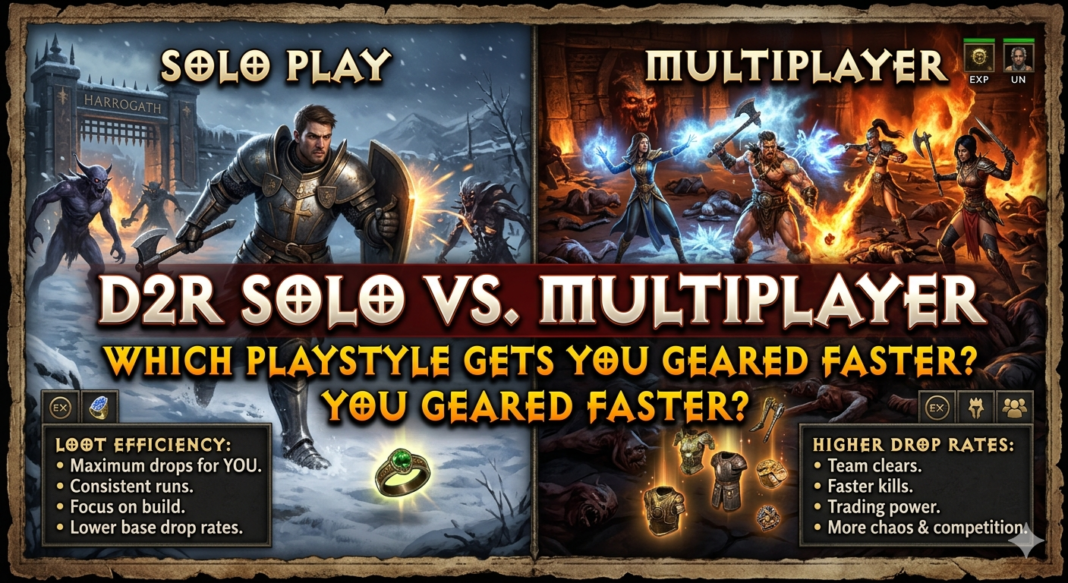
Diablo 2 Resurrected presents every player with a choice that shapes the entire experience: go it alone or run with others. On the surface it seems like a personal preference question — some people enjoy the solitude of solo play, others like the energy of a full game. But underneath that preference sits a genuinely consequential mechanical question: which approach actually gets your character geared faster?
The answer is more complicated than either camp tends to admit. Both playstyles have real advantages, both have real costs, and the fastest path to a complete character often depends on which class you are running, what gear you are chasing, and how efficiently you can operate within each format. Here is an honest look at both sides.
How Diablo 2 Resurrected Handles Loot
Before comparing playstyles, it is worth understanding the loot system they both operate within. D2R uses a model where each monster has its own loot roll — items drop individually rather than from a shared pool. Every player in a game can see and pick up their own drops, which means loot is not directly competitive between players in the way it might be in other games.
What does scale with player count is monster difficulty and, critically, the quality and quantity of drops. Running an eight-player game does not mean eight times the loot from a single monster, but it does push the drop rates and item quality upward in ways that meaningfully affect how often high-value items appear. This scaling is the foundation of the entire solo versus multiplayer gearing debate.
The Case for Multiplayer
The most straightforward argument for multiplayer gearing is that more players in a game means better drops. A Mephisto run in a full eight-player lobby produces meaningfully better drop chances than the same run done solo. For rare unique items and runeword components — the pieces that define endgame builds — that difference compounds over hundreds of runs.
Beyond raw drop rates, multiplayer opens up trade as an active gearing tool. In organized trading communities and public trade games, items circulate between players constantly. A Sorceress who farms Mephisto efficiently accumulates items that are not useful to her but are exactly what a Paladin or Necromancer player needs — and vice versa. Trading collapses the time it takes to complete a build because you are drawing from the drops of every player in the ecosystem rather than only your own.
Full clears in party play are also faster when the group is organized. A well-constructed party — with a Sorceress teleporting to bosses, a Barbarian providing Find Item for double-dipping loot, and a Paladin’s auras buffing the group — moves through content at a pace no solo character can match. The speed multiplication from a competent group is real and directly translates to more runs per hour.
The Case for Solo
The argument for solo play is less about raw drop rates and more about control, consistency, and keeping everything that drops.
In a solo game, every item that hits the ground belongs to you. There is no scramble, no concern about whether a party member grabbed something before you noticed it, and no need to negotiate over shared drops. Over a long farming session, the certainty of solo loot has genuine value — especially for items that are rare enough that seeing one drop is already an event.
Solo play also removes the dependency on other players’ schedules, connection quality, and behavior. A solo farmer sets their own pace, farms the areas they choose, and never has a run derailed by a disconnect or a party member pulling additional monsters into an uncomfortable situation. That consistency matters over the long run.
Certain classes perform better solo than others. The Sorceress, with access to teleport and strong area damage, is arguably the most efficient solo farming class in the game. A well-built Hammerdin covers similar ground. For these builds, the gap between solo and multiplayer efficiency is smaller than it is for classes that rely more heavily on party support.
What the Numbers Actually Suggest
The honest answer, when looking at the question of which playstyle gears a character faster, is that multiplayer wins in aggregate — but with significant qualifications.
A player in an active eight-person trade-enabled lobby, running efficiently with a group and trading surplus items for needed ones, will typically complete a build faster than a solo player running the same content. The combination of better drop rates and access to trade is a genuine multiplier on gearing speed.
However, that advantage assumes a high-functioning group. Random public games are inconsistent. Players leave, games end prematurely, and the time lost to reforming groups and waiting for others can erode much of the theoretical advantage. Players who have access to consistent, organized groups capture the full multiplayer benefit; those who do not may find that solo efficiency actually serves them better in practice.
The Role of External Resources
One factor that applies to both playstyles is the option to engage with the broader D2R trading ecosystem beyond the game itself. Communities built around Diablo 2 items give players access to specific gear they need without relying entirely on their own drop luck or in-game trade timing. For a player chasing a specific runeword component or a particular unique that has not dropped after dozens of targeted runs, having a reliable external option changes the calculus meaningfully.
This applies equally to solo and multiplayer players. The solo farmer who has been running Travincal for weeks without seeing a specific high rune benefits from knowing there are accessible ways to source it. The multiplayer trader who needs one specific item to complete a build mid-season has the same option. External resources do not replace the farming experience — they sit alongside it as a practical complement.
Making the Right Choice for Your Situation
The playstyle that gets you geared faster ultimately depends on circumstances more than abstract rankings. If you have a reliable group of players at similar progression levels, multiplayer will almost certainly move things along more quickly. If your schedule is inconsistent or your preferred farming targets are best done solo, the efficiency gap narrows considerably.
What matters most is playing in a way that keeps the runs enjoyable enough to sustain over the long sessions that gearing in D2R genuinely requires. The fastest path to a complete character is the one you will actually stay on — and that calculation is different for every player.

