Introduction to Mortgage Points
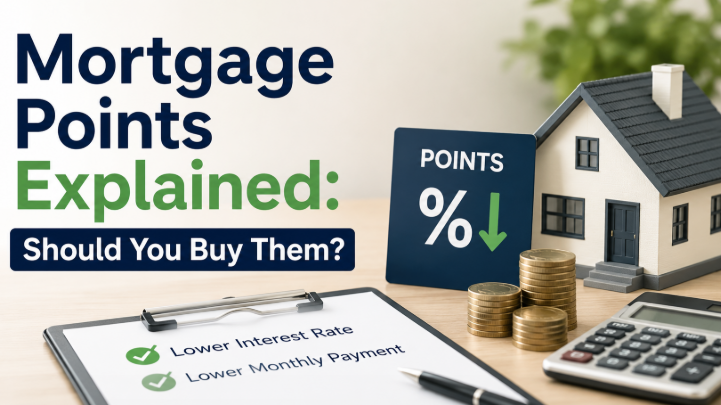
Mortgage points, commonly termed as discount points, are fees paid directly to a lender at closing in exchange for a reduced interest rate on a mortgage. This financial strategy aims to lower the monthly premium over time, ultimately yielding savings on the overall cost of borrowing. Each point typically represents 1% of the total loan amount, which can equate to significant savings depending on the loan size and interest rate involved.
The primary purpose of purchasing mortgage points is to reduce the interest rate, which can lead to lower monthly payments. For instance, a mortgage of $200,000 might incur a 4% interest rate, but by purchasing one point (which costs $2,000), the rate could potentially drop to 3.75%. While this upfront cost can seem daunting, the overall savings can be substantial when considered over the term of the loan.
Furthermore, the decision to buy mortgage points hinges on several factors, including how long the borrower plans to stay in the home, the level of savings on the monthly payment, and the potential return on investment. For those who intend to move or refinance in a shorter period, the costs of points may not recuperate as quickly, making it less advantageous. Conversely, for buyers committed to a long-term mortgage, the initial expense of purchasing points can yield considerable savings over a 30-year period.
In summary, understanding how mortgage points work is crucial for buyers looking to lower their interest payments and overall mortgage costs. When leveraged correctly, mortgage points can significantly impact the affordability of homeownership, but it is essential to evaluate individual circumstances and long-term goals before making this financial commitment.
Understanding How Mortgage Points Work
Mortgage points are a strategic financial tool used in the lending process, allowing borrowers to adjust their mortgage rates and save on overall costs. They are essentially fees paid to lenders at closing in exchange for a lower interest rate on the mortgage. This practice enables the borrower to lower their monthly payments or potentially save significant interest over the life of the loan.
There are primarily two types of mortgage points: discount points and origination points. Discount points are directly tied to the interest rate reduction on a mortgage. Each point typically costs 1% of the mortgage amount and can reduce the interest rate by approximately 0.25%, although this can vary with different lenders. This characteristic makes discount points particularly appealing for borrowers who plan to stay in their homes for an extended period, providing them the opportunity to lower their monthly payments substantially.
On the other hand, origination points are fees paid to the lender for processing the mortgage application. They are not related to interest rate adjustments and are instead considered part of the closing costs associated with securing a loan. Like discount points, origination points can also be calculated as a percentage of the loan amount, often ranging from 0% to 2%. Understanding the distinction between these two types of points is crucial for borrowers evaluating their financing options.
Incorporating these mortgage points effectively into one’s financial planning can lead to long-term savings. The choice to buy points or pay origination fees should be carefully analyzed, considering individual financial situations, plans for homeownership duration, and market conditions. This nuanced understanding of mortgage points will empower borrowers to make informed decisions regarding their mortgage financing and potentially enhance their homeownership experience.
Pros of Buying Mortgage Points
Buying mortgage points, commonly known as discount points, offers several advantages that can lead to long-term savings for homeowners. One of the primary benefits is the reduction in monthly mortgage payments. Each point purchased typically costs one percent of the total loan amount and can lower the interest rate by approximately 0.25%. This reduction may seem modest, but over the term of a 30-year mortgage, the savings on monthly payments can accumulate significantly, improving your cash flow.
Furthermore, purchasing mortgage points can provide substantial savings on the overall interest paid throughout the duration of the loan. Lowering the interest rate means that less interest is charged over time, translating to considerable dollar savings. For instance, if a homeowner takes out a $300,000 mortgage and buys two points, reducing their rate from 4.5% to 4%, they could save tens of thousands in interest payments by the end of the loan term.
Buying mortgage points can also be beneficial for those who plan to stay in their homes for an extended period. When calculating the break-even point, or the time it takes for the savings from lower monthly payments to exceed the upfront cost of the points, homeowners who intend to remain in their properties for several years can realize significant financial advantages. This long-term strategy can make homeownership more affordable in the long run.
Additionally, mortgage points might offer tax benefits. Homeowners can typically deduct the cost of points from their taxable income, providing further financial relief. This aspect can enhance the overall value proposition of purchasing points.
Cons of Buying Mortgage Points
While buying mortgage points offers potential long-term savings on interest rates, there are several notable drawbacks that borrowers should consider. One of the primary concerns is the significant upfront costs associated with purchasing these points. Typically, one mortgage point costs one percent of the total loan amount. For instance, on a $300,000 mortgage, buying one point would require an investment of $3,000. This initial expenditure can strain personal finances, especially for those already managing considerable upfront costs during the home-buying process.
Additionally, investing in mortgage points can negatively impact an individual’s financial liquidity. By allocating a substantial amount of cash toward mortgage points, homeowners may find themselves with less available liquid assets. This reduced cash flow can be problematic in case of emergencies, unexpected expenses, or other financial needs that arise post-purchase. Money spent on points cannot be used for other investments, savings, or necessary purchases, leading to potential financial stress.
Moreover, the savings generated through lower monthly mortgage payments may not occur quickly enough to justify the initial investment. For buyers who do not plan to stay in their homes for an extended period, the break-even point—the length of time it takes for the reduced rate to repay the costs of buying points—may never be reached. If the homeowner sells or refinances before reaching this break-even point, they may not recoup their investment, resulting in financial loss. In these situations, the decision to buy mortgage points can prove to be unwise—or at least not advantageous—for the homeowner.
Calculating the Break-Even Point
When considering whether to buy mortgage points, it is crucial to calculate the break-even point to understand how long it will take to recoup the cost of these points through reduced monthly mortgage payments. Mortgage points, or discount points, essentially allow you to pay upfront to lower your interest rate, which can lead to significant savings over the life of the loan.
To calculate the break-even point, start by determining the cost of the mortgage points. Generally, one mortgage point costs 1% of the loan amount and reduces the interest rate by approximately 0.25%. For example, if you have a $300,000 mortgage and choose to buy two points, you would pay $6,000 upfront ($300,000 x 2%). Next, find out how much your monthly payment will decrease as a result of this purchase. This can be calculated using a mortgage calculator which factors in different interest rates and principal amounts.
Once you know the decrease in your monthly payments, you can determine how long it will take to recover the $6,000 cost in savings. Divide the total cost of the mortgage points by the monthly savings. For instance, if buying points reduces your payment by $150 per month, the break-even point would be 40 months ($6,000 / $150). It is essential to consider how long you plan to stay in your home since if you move before reaching the break-even point, the upfront cost may not be worth the investment.
In conclusion, calculating the break-even point is a key element in deciding whether to purchase mortgage points. By evaluating the upfront cost against the monthly payment savings, homeowners can make informed decisions tailored to their financial situation and long-term plans.
When Buying Mortgage Points Makes Sense
Purchasing mortgage points, commonly referred to as buying down the interest rate, can be a strategic decision for many borrowers. It involves paying a percentage of the loan amount upfront to reduce the interest rate on the mortgage, resulting in lower monthly payments over the life of the loan. However, this option is not universally beneficial; certain scenarios present a more compelling case for buying mortgage points.
One favorable condition for purchasing points arises during a low interest rate environment. When mortgage rates are at historical lows, securing an even lower rate through points can lead to substantial long-term savings. By analyzing the potential monthly payment reduction and the total interest paid over the loan term, borrowers can determine if the upfront cost of points is justified. Generally, the longer you plan to stay in your home, the greater the financial benefit.
Individual financial situations also play a critical role in deciding whether to buy points. For individuals with sufficient liquid assets, paying for points could be a wise investment, particularly if they can afford the initial cost without jeopardizing their savings. On the other hand, borrowers operating on a tight budget may find that using those funds for closing costs or emergency savings provides immediate value.
Furthermore, potential tax implications should not be overlooked. Mortgage points are sometimes deductible as interest on tax returns, which can provide an additional incentive for buyers who itemize deductions. Therefore, consulting with a tax professional can provide further insights into how purchasing points may impact your overall financial situation.
Ultimately, buying mortgage points makes sense in specific circumstances, primarily when current market conditions are advantageous, and individual financial contexts align with long-term housing goals. By carefully weighing these factors, borrowers can make informed decisions that align with their financial objectives.
Alternatives to Buying Mortgage Points
When considering your options for reducing mortgage costs, homeowners may explore alternatives to purchasing mortgage points. One key alternative is adjusting the loan term, which can significantly influence the monthly payments. A shorter loan term often equates to higher monthly payments but can lead to lower interest costs over the life of the loan. Conversely, extending the loan term may reduce monthly payments, albeit at the expense of paying more interest overall.
Another viable option is to increase the down payment. By contributing more money upfront, a homeowner can lower the principal balance on the loan. This adjustment can decrease monthly payments and the total interest paid over the loan’s lifespan, similar to how buying points may lower the interest rate. Furthermore, a larger down payment can help borrowers avoid private mortgage insurance (PMI), which is typically required when the down payment is less than 20% of the home’s value.
Homeowners might also explore different loan programs or interest rate options available from various lenders. For instance, some lenders offer fixed-rate mortgages, while others provide adjustable-rate mortgages (ARMs). An ARM often starts with a lower interest rate that can be more appealing, though it poses risks if rates increase over time. Additionally, shopping around for the best rates and terms can lead to substantial savings, which might negate the need to buy points altogether.
Lastly, considering government-backed loan programs such as FHA or VA loans can provide lower interest rates or reduced costs. These options, alongside the adjustments to loan terms and down payments, offer multiple pathways for homeowners to manage their mortgage costs effectively without resorting to purchasing mortgage points.
Expert Opinions and Case Studies
Understanding the effectiveness of purchasing mortgage points requires examining expert opinions and real-world case studies. Mortgage points, which allow borrowers to reduce their interest rates by paying upfront fees, can be a strategic financial choice depending on individual circumstances. For instance, financial advisor Sarah Johnson recommends that buyers evaluate their long-term plans before deciding to buy points. She emphasizes that for those intending to stay in their homes for an extended period, purchasing points can lead to significant savings on interest over the loan’s life. The upfront cost, in this case, is often offset by lower monthly payments.
To illustrate this, consider the case of a young couple, Mark and Jessie, who bought a home with a mortgage of $300,000 at a 4% interest rate. They opted to purchase two points, amounting to $6,000, which reduced their interest to 3.75%. By analyzing their potential savings, they discovered that over the course of 30 years, their decision would save them approximately $45,000 in interest payments. This scenario emphasizes the potential benefits of purchasing points when a borrower expects to keep their mortgage for the long haul.
Conversely, some experts caution against purchasing points in certain circumstances. Mortgage consultant David Acker questions the logic of buying points for individuals who plan to move within a few years. David cites a case where a client bought points, but unforeseen circumstances required them to relocate just two years later. In this scenario, the upfront cost of the points resulted in little or no financial benefit, showcasing that short-term plans can render the purchase of mortgage points an unwise financial choice.
In analyzing such opinions and case studies, it is evident that the decision to buy points hinges on various factors including length of stay, financial stability, and market conditions. Therefore, potential homebuyers should carefully consider their situation and perhaps consult with mortgage experts before making a decision.
Conclusion and Key Takeaways
In navigating the complexities of mortgage financing, the decision to buy mortgage points is a significant one that can impact both immediate costs and long-term financial outcomes. Throughout this blog post, we have examined the definition of mortgage points, how they function, and the implications associated with purchasing them. Mortgage points, or discount points, serve as a mechanism for borrowers to reduce their overall interest rate, thus potentially resulting in lower monthly payments and significant savings over the course of the loan.
It is essential to weigh the benefits against the costs associated with buying mortgage points. While an upfront payment can lead to lower interest payments, the duration of time you intend to stay in your home plays a crucial role in determining whether this investment is worthwhile. If you plan to remain in your home for a long duration, the savings accrued from a lower interest rate may exceed the initial costs of the points purchased.
Moreover, every borrower’s financial situation differs, and factors such as credit score, market conditions, and overall financial goals should be considered. Homebuyers should also evaluate alternative strategies, such as placing additional funds toward a larger down payment or exploring different mortgage products that do not involve points.
Ultimately, making an informed decision about buying mortgage points requires careful consideration of personal financial circumstances and future plans. By analyzing all aspects discussed in this post, borrowers can better position themselves to optimize their mortgage financing and potentially enhance their financial stability. Before proceeding, a detailed assessment or consultation with a financial advisor may provide further clarity and assistance in making the right choice.

