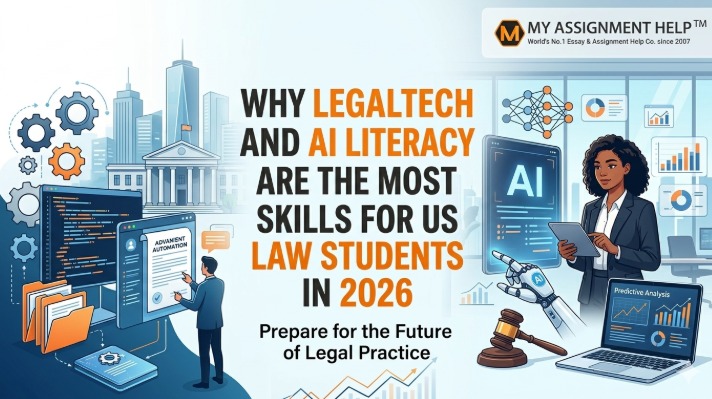
The legal landscape in the United States has reached a definitive tipping point. As we move through 2026, the image of a law student buried under stacks of physical casebooks is increasingly becoming a relic of the past. Today, the “black letter law” is being rewritten in code, and the most successful graduates are those who can navigate the complex intersection of jurisprudence and generative intelligence.
For the Class of 2026, proficiency in Lexis+ AI, Westlaw Precision, and specialized CLM (Contract Lifecycle Management) tools is no longer a “bonus” on a resume—it is the baseline. The American Bar Association (ABA) has underscored this shift, emphasizing that technological competence is a core component of professional duty. As law firms lean into automation to reduce billable hours for routine tasks, students must adapt to provide higher-level strategic value.
The pressure to master these evolving technologies while maintaining a high GPA can be overwhelming. Many students find themselves balancing complex litigation simulations with intensive technical training. In such a high-stakes environment, it is common for students to seek out an assignment writing service to manage the heavy load of research papers and case briefs, allowing them to focus on the hands-on technical skills that will define their careers.
The Evolution of Legal Research: From Keywords to Prompt Engineering
In 2026, legal research has evolved beyond simple Boolean operators and keyword searches. The integration of Large Language Models (LLMs) into primary legal databases means that law students are now “Prompt Engineers” as much as they are “Legal Researchers.”
This transition requires a fundamental shift in cognitive approach. Students are no longer just looking for a case that matches their facts; they are training machines to synthesize vast quantities of data into actionable legal strategy.
- Semantic Search Mastery: Understanding how AI interprets legal intent rather than just matching words. Modern tools allow for natural language queries that understand nuances in “intent” and “context” which were previously lost in older databases.
- Verification and “Hallucination” Protocols: The rise of “AI Hallucinations” in the early 2020s led to the 2026 standard of rigorous manual verification. Students must now master the art of “shepardizing” AI-generated citations to ensure accuracy. A single uncited or false reference can lead to sanctions under Rule 11.
- Efficiency Gains and Firm Expectations: Studies indicate that AI-integrated workflows can reduce document review time by up to 40%. US law firms now expect incoming associates to complete in two hours what used to take an entire workday.
Managing these technical shifts alongside traditional coursework requires a strategic approach to time management. When the complexity of a 30-page memo on Tort Law conflicts with a seminar on Blockchain Regulation, some students choose to delegate their non-core tasks and ask a professional to do my homework to ensure they don’t fall behind in their specialized LegalTech certifications.
The Three Pillars of LegalTech Literacy in 2026
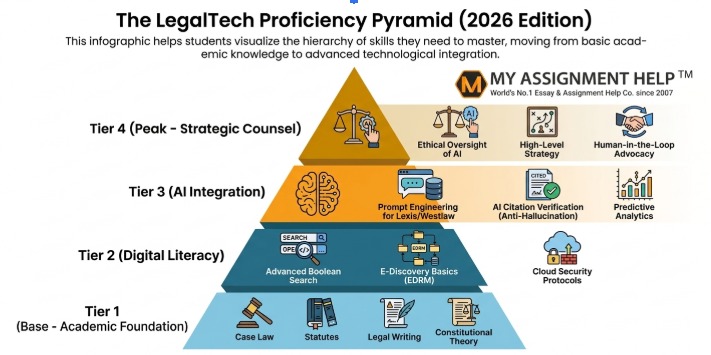
To be competitive in the 2026 US job market, a law student’s literacy must extend into three specific domains:
1. Generative AI and Predictive Analytics
Predictive coding is now used to forecast judicial outcomes. By analyzing thousands of past rulings from specific judges, AI can suggest the most persuasive arguments or even predict the likelihood of a settlement. Law students must understand the data sets behind these tools to identify and argue against algorithmic bias—a growing area of litigation.
2. Cybersecurity and Client Data Privacy
With the increase in remote litigation and cloud-based practice management, the US legal market is a prime target for cyber threats. Students must be literate in encrypted communication, secure document sharing, and the ethical implications of data storage under evolving state-level privacy laws like the CCPA.
3. E-Discovery and Digital Forensics
The bulk of evidence in modern litigation is digital—Slack messages, encrypted texts, and metadata. Literacy in E-Discovery platforms (like Relativity or Everlaw) is now as fundamental as understanding the Rules of Evidence. Modern 1Ls are often expected to understand the Electronic Discovery Reference Model (EDRM) before their first summer internship.
Data-Driven Insights: The 2026 Labor Market
The shift toward technology is reflected in the hiring data. According to recent 2026 legal industry reports, mid-to-large sized US firms have increased their “LegalTech” budget by 25% year-over-year, often at the expense of traditional clerical roles.
| Skillset | Demand Increase (2024-2026) | Starting Salary Premium (USD) |
| AI Prompt Engineering | +65% | $15,000 – $25,000 |
| Cybersecurity Law | +40% | $12,000 – $18,000 |
| Data Analytics & Visualization | +35% | $8,000 – $12,000 |
| Traditional Litigation (Only) | +5% | Baseline |
Source: 2026 Legal Workforce Analysis & NALP Trends.
Strategic Learning Tools: The LegalTech Survival Framework
The modern law student’s journey is no longer linear. It is a continuous loop of learning, applying, and automating. To help students visualize this transition, we use the Legal Engineering Lifecycle.
- Foundational Research: Using AI to summarize 100+ years of case law.
- Strategic Analysis: Identifying gaps in AI summaries using human “Expertise.”
- Drafting & Automation: Using CLM tools to generate the first draft of contracts or motions.
- Final Ethical Review: Applying the “Trustworthiness” pillar of EEAT to finalize documents.
The Ethical Mandate: Tech Competence as a Duty
The American Bar Association (ABA) Model Rule 1.1, Comment 8, explicitly states that a lawyer must keep abreast of the changes in the law and its practice, including the benefits and risks associated with relevant technology. In 2026, failing to use a cost-saving AI tool could potentially be seen as a violation of a lawyer’s fiduciary duty to their client to provide efficient representation.
Students who ignore this trend are not just falling behind; they are entering the workforce with an “expertise gap” that is increasingly difficult to close. By embracing LegalTech, students transition from being “knowledge workers” to “strategic advisors.”
Key Takeaways
- Technological Duty: Technical competence is an ethical requirement, not an elective.
- Efficiency is Currency: Law firms in 2026 value the ability to deliver high-quality work in a fraction of the traditional time.
- Human-in-the-Loop: AI is a powerful co-pilot, but human oversight is required to maintain E-E-A-T (Experience, Expertise, Authoritativeness, and Trustworthiness).
- Strategic Outsourcing: Utilizing professional academic services for secondary tasks allows students to focus on the high-level tech skills that command six-figure salaries.
Frequently Asked Questions (FAQ)
Q1: Will AI eventually replace junior lawyers in the US?
While AI is replacing many “process-heavy” tasks like initial document review and basic drafting, it cannot replace the nuanced judgment, ethical weighing, and emotional intelligence required for client counseling and courtroom advocacy.
Q2: What is the most important tool for a 1L student to learn?
Start with the AI-enhanced versions of Lexis+ or Westlaw. Understanding how these platforms have integrated generative AI into “Shepard’s” and “KeyCite” is vital for accurate research.
Q3: How do I demonstrate “AI Literacy” on a resume?
List specific certifications (e.g., Relativity Certified Pro) and mention specific use-case examples, such as “Reduced research time for constitutional law briefs by 30% using predictive analytics tools.”
References
- American Bar Association (2025). “The Evolution of Model Rule 1.1: Technology as a Core Competency.”
- Stanford Legal Design Lab (2026). “The Impact of Generative AI on Legal Education.”
- Journal of High Technology Law (2026). “Predictive Analytics in US District Courts.”
- National Association for Law Placement (NALP) 2026 Salary Report.
About the Author
Dr. Aris Thorne
Senior Academic Consultant & LegalTech Strategist at MyAssignmentHelp
Dr. Thorne has over a decade of experience in legal pedagogy and digital transformation. Currently leading the Digital Literacy Initiative at MyAssignmentHelp, Dr. Thorne focuses on helping US law students bridge the gap between traditional theory and modern legal practice. His work ensures that academic content meets the highest standards of authority and professional relevance for today’s competitive legal market.

